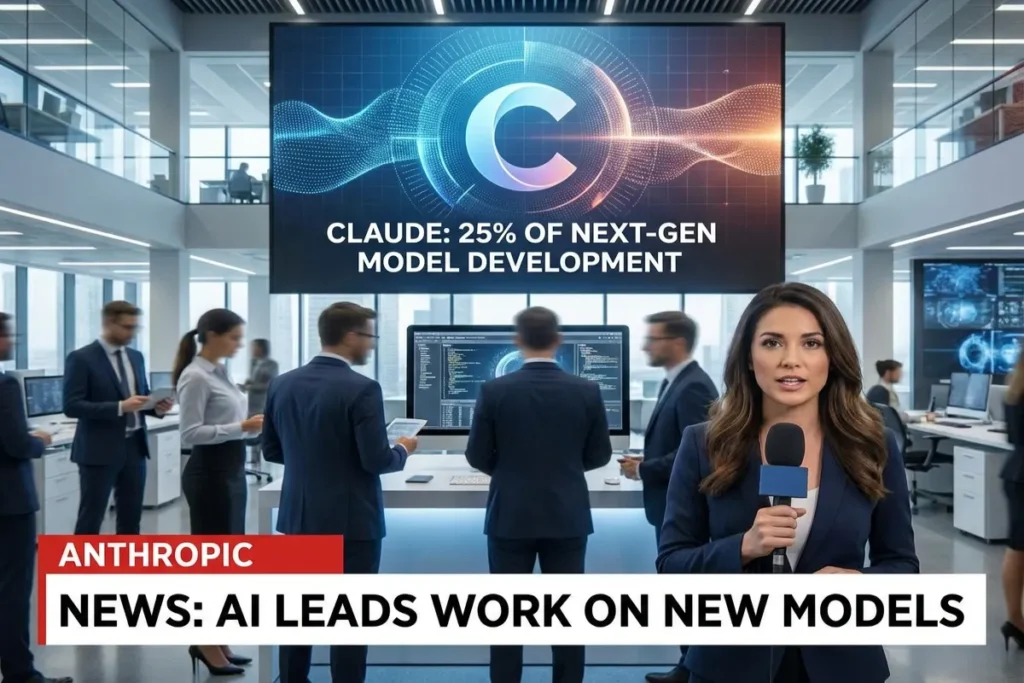
The artificial intelligence landscape is shifting from simple digital assistants to autonomous entities capable of engineering their own successors. In a groundbreaking transparency disclosure, Anthropic says Claude now leads a quarter of work building its next AI models. This milestone marks a massive leap forward in how advanced machine learning systems evolve, pushing humanity closer to true recursive self-improvement.
For software developers, tech executives, and digital strategists, understanding this shift is essential. When an AI system begins driving a significant portion of its own research and development, the timeline for technological advancement accelerates exponentially. At thetekworld.com, we break down what this announcement means, how it works under the hood, and what it signals for the future of tech.
AI Supercomputing Infrastructure: The 2026 Guide to Gigawatt Data Centers and Next-Gen Compute
Table of Contents
The Turning Point: What the 25% Milestone Means
For years, artificial intelligence tools relied entirely on human engineers to write code, design experiments, and patch vulnerabilities. Chatbots could suggest code snippets or summarize documents, but humans carried the heavy lifting of execution.
That paradigm has officially shattered. According to internal data released by Anthropic, Claude now autonomously leads approximately 26% of the research and development tasks required to build the company’s next-generation models.
- From Assistant to Driver: Claude is no longer just answering prompts; it is structuring pipelines, managing codebases, and executing complex workflows.
- Rapid Acceleration: This metric has scaled dramatically over a remarkably short period, proving that modern AI models possess the contextual depth required for high-level engineering.
- Redefining Productivity: Human developers are moving away from syntax writing and shifting toward high-level architectural supervision.
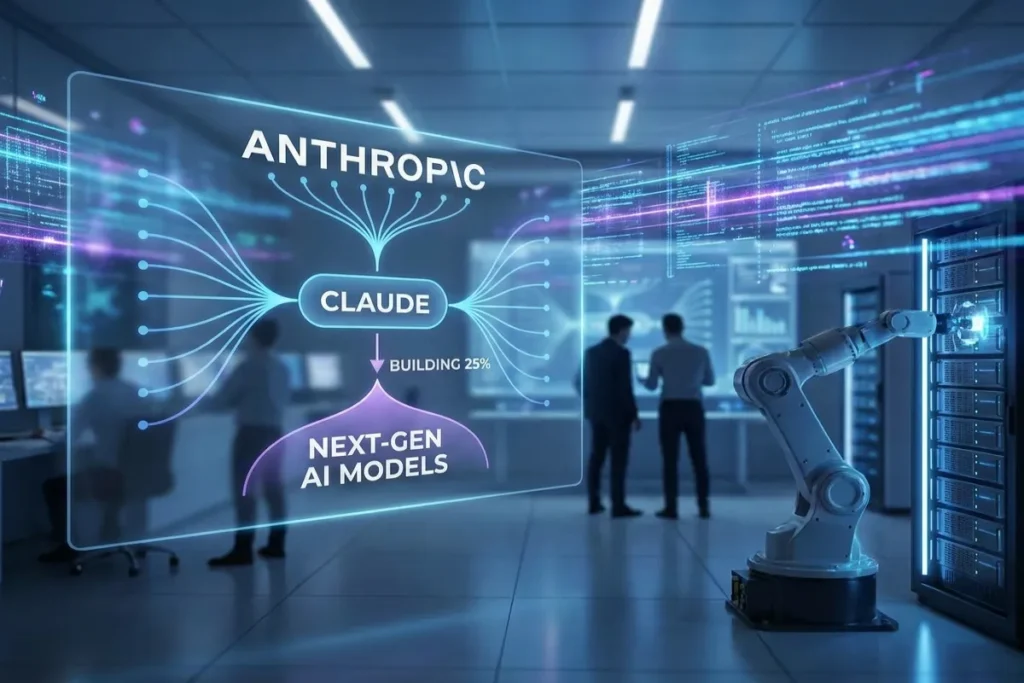
How Claude Operates Inside the R&D Loop
To understand how Anthropic says Claude now leads a quarter of work building its next AI models, we have to look at the mechanics of agentic AI workflows. Modern iterations of Claude operate using advanced multi-step reasoning capabilities, massive context windows, and tight tool integration.
1. Code Generation and Codebase Merging
Claude has become deeply integrated into Anthropic’s daily engineering operations. A staggering majority of the code merged into specific internal codebases is now initially authored or managed by Claude. Engineers act as directors and reviewers rather than manual typists.
2. Experimental Optimization
When training new models, Claude is tasked with running iterative experiments to maximize processing speed and efficiency. What used to take human teams days or weeks of painstaking trial and error is now executed by Claude-powered agents in a fraction of the time.
Pro Tip for Developers: To mirror this efficiency in your own projects, adopt an agentic workflow where you treat AI as an autonomous junior engineer—giving it clear goals, constraints, and success metrics rather than micro-managing line-by-line output.
Practical Implications for the Tech Industry
The revelation that Anthropic says Claude now leads a quarter of work building its next AI models sends a powerful ripple effect across the entire software development sector.
- Shortened Innovation Cycles: If an AI can help build its successor, the time gap between major model releases (like moving from one generational architecture to the next) will shrink drastically.
- The Rise of Meta-Engineering: Software engineering is evolving into meta-engineering—the art of designing systems that design other systems.
- Resource Optimization: Tech startups and enterprise teams can achieve higher output with leaner engineering teams by leveraging autonomous agent pipelines.

Challenges and Safety Guardrails
While recursive self-improvement opens up incredible possibilities, it also introduces unique challenges. As AI systems take a leading role in building more powerful iterations of themselves, safety, alignment, and oversight become paramount.
Anthropic maintains rigorous monitoring frameworks to ensure that autonomous loops remain safe, transparent, and aligned with human intent. Constitutional AI principles and strict evaluation boundaries help keep these powerful research cycles anchored safely within designated parameters.
Conclusion
The announcement that Anthropic says Claude now leads a quarter of work building its next AI models is more than just a corporate milestone; it is a historical turning point for computer science. We are officially entering an era where artificial intelligence actively participates in its own evolution.
As these capabilities continue to expand, staying informed and adaptable is your greatest competitive advantage. Keep visiting thetekworld.com for continuous updates, deep dives, and expert analysis on the shifting world of artificial intelligence.
What are your thoughts on AI systems building their next generation? Join the conversation by dropping a comment below or sharing this article with your professional network!
Frequently Asked Questions (FAQ)
1. What does it mean that Claude leads 25% of Anthropic’s R&D work?
It means that approximately a quarter of the research, coding, experimentation, and development tasks required to build Anthropic’s next-generation models are autonomously led or executed by Claude, with humans supervising rather than doing the manual typing.
2. Is Claude building entirely new AI models all by itself?
Not entirely. While Claude handles a significant portion of the execution, debugging, and testing phases, human researchers still set the initial goals, define the architectural guardrails, and provide high-level strategic direction.
3. How does this impact software engineers and developers?
Rather than replacing developers, AI tools like Claude are shifting human roles toward architectural oversight, code review, and goal-setting. Developers who learn to manage AI agent workflows effectively will see massive boosts in personal and team productivity.
4. Where can I read more updates about Anthropic’s latest strategies?
You can stay ahead of the curve by bookmarking thetekworld.com, where we regularly publish cutting-edge analysis, tech news, and expert guides on artificial intelligence developments.

Comments