If your organization is scaling artificial intelligence in 2026, you are likely hitting a massive, unavoidable wall. It is no longer just about hiring top-tier machine learning engineers or securing the latest open-weight foundational models. The true bottleneck for modern AI deployment is physical. Traditional data centers simply cannot handle the extreme thermal density and massive power draws required by today’s deep learning clusters. To stay competitive, enterprises and hyperscalers are rapidly shifting their focus toward a new class of technology: AI Supercomputing Infrastructure.
We have entered a world where global data creation is accelerating toward 181 zettabytes by the end of this year. Simultaneously, generative AI and large language models (LLMs) are demanding computational resources on a scale previously reserved for national defense projects. This has triggered a profound transformation. The global investment in AI infrastructure is projected to hit a staggering $31.6 trillion through 2050, with global data center spending reaching roughly $800 billion in 2026 alone.
This comprehensive guide will explore what AI supercomputing infrastructure entails, why power is the new defining metric, and how organizations can strategically build, scale, and future-proof their compute investments for the gigawatt era.
The Ultimate Guide to Autonomous “Agentic” AI & Multi-Agent Systems in 2026
Table of Contents
What is AI Supercomputing Infrastructure?
AI Supercomputing Infrastructure refers to purpose-built, high-performance computing (HPC) environments specifically engineered to train, fine-tune, and run inference for massive artificial intelligence models.
Unlike traditional cloud data centers—which are designed for distributed, multi-purpose workloads like web hosting, databases, and microservices—AI supercomputers are built for massive parallel processing. They are designed as a single, cohesive engine. When training a trillion-parameter LLM, thousands of GPUs must act as one synchronized brain. If even a single network link drops packets or a single rack overheats, the entire training run can stall, wasting millions of dollars in compute time.
To prevent these failures, AI supercomputing infrastructure fundamentally redesigns the data center from the ground up. The core pillars of this infrastructure include:
- Ultra-Dense Compute: Moving away from standard CPU racks to tightly packed arrays of specialized AI accelerators (GPUs, TPUs, and LPUs).
- Advanced Thermal Management: Phasing out traditional forced-air cooling in favor of direct-to-chip liquid cooling and full immersion systems.
- High-Bandwidth, Low-Latency Networking: Utilizing silicon photonics, high-speed optical interconnects, and non-blocking network topologies to ensure data flows continuously between tens of thousands of chips.
- Colossal Power Delivery: Scaling electrical infrastructure to support facilities that draw hundreds of megawatts, or even gigawatts, of continuous power.
By late 2026, AI is expected to account for nearly 50% of total data center workloads, with AI inference beginning to overtake model training as the dominant use case.
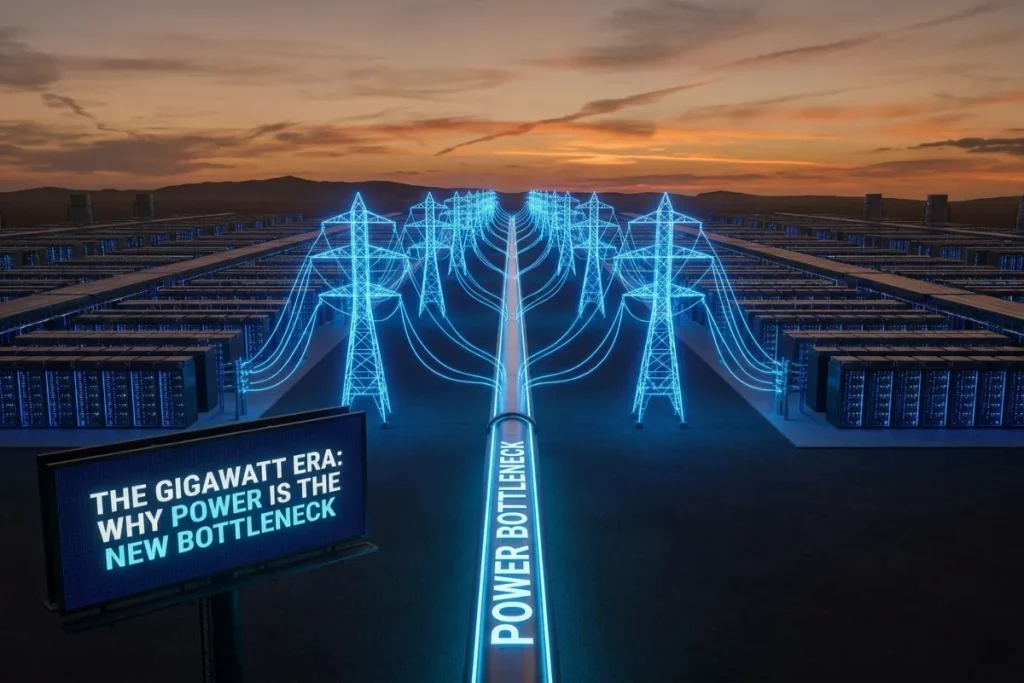
The Gigawatt Era: Why Power is the New Bottleneck
For decades, the success of a supercomputer was measured in FLOPS (Floating Point Operations Per Second). In 2026, the most critical metric for AI supercomputing infrastructure is the Megawatt (MW)—and increasingly, the Gigawatt (GW).
The sheer energy density of modern AI chips is staggering. A single rack of next-generation AI accelerators can consume over 120 kilowatts (kW) of power, compared to the 10kW to 15kW average of a traditional enterprise rack. When you scale this to clusters containing hundreds of thousands of GPUs, the power requirements rival those of major cities.
Private Hyperscale Campuses vs. The Power Grid
The grid is struggling to keep up. Because utilities often take years to provision new high-voltage transmission lines, hyperscalers and AI developers are taking extreme measures to secure power. We are now seeing the rise of private, gigawatt-scale AI training campuses that operate outside the traditional national lab model:
- xAI’s Colossus 2: Located in Memphis, this site is bypassing traditional utility wait times by generating massive amounts of power on-site, targeting a 2 GW capacity to support roughly 555,000 GPUs.
- Microsoft’s Fairwater Campus: A multi-hundred-megawatt facility in Wisconsin that utilizes closed-loop liquid cooling to eliminate operational water consumption, paving the way for multi-GW expansion.
- Nuclear-Powered AI: In a massive shift, companies like Meta are signing direct agreements with advanced nuclear providers (such as TerraPower and Oklo) to supply 1 GW of clean, firm operational capacity for their AI sites.
Power availability is the absolute decisive factor shaping where AI supercomputing infrastructure investment flows globally today. Without affordable, reliable, and low-carbon electricity, scaling AI is impossible.
Interactive: AI Cluster Energy & Footprint Calculator
To truly understand the scale of these facilities, use the tool below to estimate the power and footprint of an AI supercomputing cluster. Adjust the GPU count and cooling types to see how thermal management impacts total energy draw.
Key insight: Switching from air cooling to liquid immersion in the calculator drastically reduces the Power Usage Effectiveness (PUE) overhead, meaning millions of dollars saved on electricity bills annually for a gigawatt-scale data center.
Core Components of 2026 AI Data Centers
Building AI supercomputing infrastructure requires a symphony of cutting-edge hardware. Let’s break down the physical components that make these gigawatt data centers possible.
1. Ultra-Dense GPU and Accelerator Clusters
The heart of the AI supercomputer is the accelerator. While CPUs handle general-purpose tasks and orchestration, GPUs (Graphics Processing Units) and specialized AI chips perform the heavy mathematical lifting required for matrix multiplication.
In 2026, the hardware landscape is dominated by dense, interconnected node architectures. Systems are no longer just a collection of loose servers; they are highly integrated chassis where memory, compute, and networking are unified. The AI supercomputing platforms market is heavily reliant on this compute systems segment, which held a 33% market share recently.
Actionable Tip: When procuring compute clusters, prioritize High-Bandwidth Memory (HBM) capacity over raw core counts. Model inference and fine-tuning are frequently memory-bandwidth constrained, meaning the chips spend more time waiting for data than actually computing.
2. Advanced Liquid Cooling Architectures
Air cooling is officially dead in the realm of frontier AI training. Air simply lacks the thermal density required to extract heat from racks drawing 100kW to 120kW. Forcing chilled air through these servers requires massive, deafening fans that consume up to 20% of the facility’s total power.
AI supercomputing infrastructure now relies on two primary cooling methods:
- Direct-to-Chip (D2C) Liquid Cooling: Cold plates are mounted directly onto the GPUs and CPUs. A specially formulated coolant (or sometimes purified water) flows through micro-channels in the plates, absorbing heat instantly. This allows for extremely dense rack designs.
- Immersion Cooling: Entire server chassis are submerged in large vats of non-conductive, engineered dielectric fluid. The fluid boils upon contact with the hot chips, turning into vapor, rising to a condenser, and raining back down as a liquid. This offers the ultimate thermal efficiency and near-silent operation.
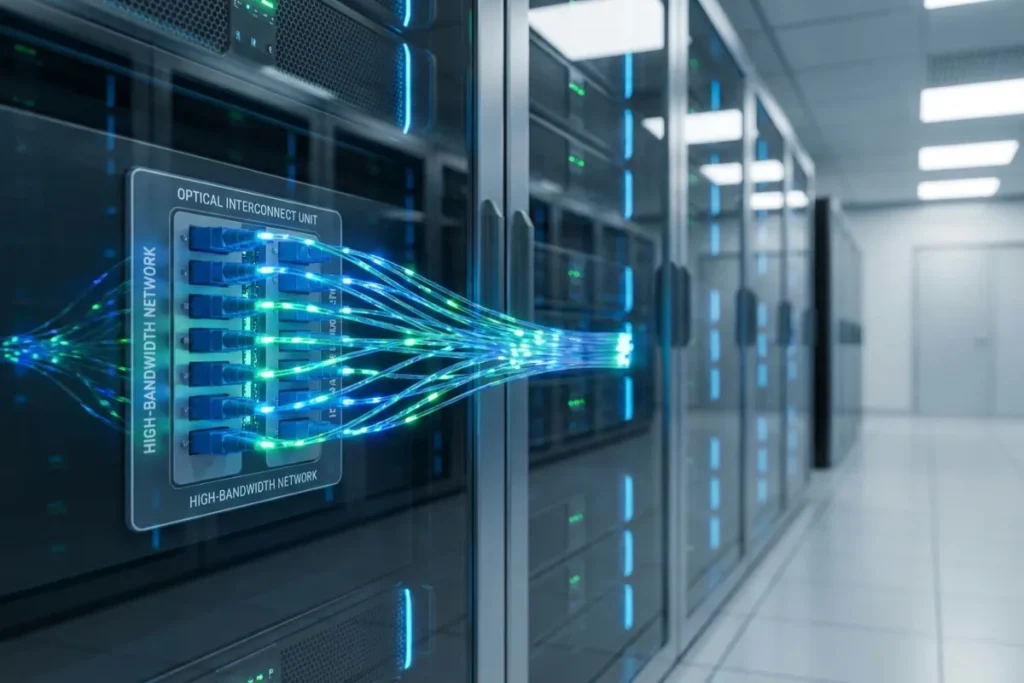
3. Optical Interconnects and High-Bandwidth Networking
An AI supercomputer is only as fast as its slowest network cable. In massive LLM training jobs, the model parameters and gradients must be continuously synchronized across tens of thousands of GPUs. This requires a network topology that guarantees zero packet loss and microsecond latency.
To achieve this, 2026 AI supercomputing infrastructure relies heavily on Optical Interconnects. Traditional copper cables suffer from signal degradation over short distances when pushing 800 Gbps or 1.6 Tbps of data. Silicon photonics—where data is transmitted via lasers over fiber optic glass directly from the chip—is now the standard.
Networking protocols have also evolved. While InfiniBand has historically been the gold standard for supercomputing due to its deterministic performance, advanced AI-optimized Ethernet (like Ultra Ethernet) is rapidly gaining market share. It offers the familiar management interfaces of enterprise IT while matching the performance required by massive AI clusters.
Designing AI Supercomputing Infrastructure for Scale
Transitioning from pilot AI programs to full-scale enterprise implementation requires a rigid operational strategy. The current market environment is seeing a slight shift—a focus on ROI rather than just blind spending. Companies are moving toward “tokenminning” (minimizing token waste and optimizing costs) as AI operating costs rise.
If your organization is building or leasing AI supercomputing infrastructure, follow these actionable best practices:
1. Optimize Your Power Usage Effectiveness (PUE)
Aim for a PUE of 1.1 or lower. Every watt spent on cooling is a watt not spent on compute. Partner with colocation providers that utilize natural free cooling (building in cold climates) or advanced closed-loop liquid systems that do not drain local municipal water supplies.
2. Implement “Agentic” Guardrails
As organizations deploy agentic AI (AI systems that act autonomously on behalf of the user), the underlying infrastructure must support robust governance. Your network architecture should isolate sensitive databases from external-facing AI agents to prevent “agentic drift” or catastrophic system failures. Ensure your storage architecture provides immutable backups to protect against autonomous errors.
3. Adopt Open-Weight Models for Sovereignty
Data privacy and national security are driving a massive push toward Digital Sovereignty. Relying solely on API calls to foreign hyperscalers introduces geopolitical risk. By investing in on-premises or localized AI supercomputing infrastructure, enterprises can host open-weight models (like Llama or Mistral) entirely within their own secure borders. This ensures that proprietary corporate data never leaves the facility.
4. Build for Iterative Upgrades
Unlike traditional real estate or infrastructure booms, AI data centers require continuous technology refreshes. Chip generations move fast. Ensure your rack designs, power busways, and liquid cooling manifolds are modular. You should be able to swap out 2026-era accelerators for next-generation hardware in 2028 without tearing down the building.

Market Trends and the $31.6 Trillion Horizon
The economic scale of the AI infrastructure boom is unprecedented. According to recent forecasts, global investment in AI infrastructure will hit a record $31.6 trillion by 2050. This is not a temporary bubble; it is a permanent rewiring of global computing.
The Rise of Sovereign AI
Governments are no longer leaving AI compute entirely to private tech giants. They view compute capacity as critical national infrastructure. For example, Saudi Arabia’s Public Investment Fund is aggressively rolling out a massive AI cluster targeting up to 500 MW. We are seeing similar sovereign strategies accelerating infrastructure investments across Europe and the Asia Pacific, fundamentally redistributing global supply chains.
Shift from Training to Inference
While the headlines are dominated by the massive LLM training clusters, the long-tail economic driver of AI supercomputing infrastructure is inference—the actual daily use of the models. The global AI supercomputing platforms market is heavily driven by this shift, as businesses integrate AI into customer service, software development, and real-time data analysis. Inference requires infrastructure that is highly geographically distributed (Edge AI) to reduce latency for end-users, pushing data center growth into tier-two and tier-three cities globally.
How to Future-Proof Your AI Compute Investments
Building AI infrastructure is risky. Misjudging the market or locking into the wrong hardware ecosystem can lead to billions in stranded assets. To protect your investments, organizations must maintain extreme agility.
- Diversify Accelerator Silicon: Do not lock your software stack to a single vendor’s proprietary code base. Utilize abstraction layers and open-source frameworks (like PyTorch and Triton) that allow your workloads to run efficiently across different silicon platforms.
- Embrace Hybrid-Compute Architectures: The future of supercomputing isn’t just AI accelerators; it is the convergence of AI with quantum computing. As demonstrated by the Jupiter supercomputer in Germany, which recently achieved record simulations of a quantum computer using AI superchips, the next decade will require infrastructure that can seamlessly hand off tasks between classical GPUs and quantum processing units (QPUs).
- Focus on the Data Pipeline: The fastest GPU cluster in the world is useless if it is starved for data. The storage systems segment is witnessing massive growth. Invest heavily in ultra-fast, scalable NVMe storage fabrics to ensure that your massive volumes of unstructured data can be ingested by the AI models at peak bandwidth.
Conclusion
The transition to AI Supercomputing Infrastructure represents the largest capital allocation challenge of this generation. We are moving out of the megawatt era and stepping firmly into the gigawatt era. For enterprises, hyperscalers, and governments alike, the mandate is clear: adapt your physical infrastructure to the extreme demands of artificial intelligence, or be left behind by those who do.
By embracing high-density compute, transitioning to liquid cooling, optimizing massive power grids, and planning for continuous hardware evolution, your organization can build a resilient foundation for the next decade of AI innovation.
Are you ready to optimize your enterprise IT stack for the AI revolution? Visit thetekworld.com for more deep dives, industry reports, and expert guidance on scaling your digital infrastructure securely and efficiently.
Frequently Asked Questions (FAQs)
1. What is the difference between traditional cloud infrastructure and AI supercomputing infrastructure?
Traditional cloud is built for flexibility and hosting millions of small, independent applications. AI supercomputing infrastructure is designed as a single, massive engine built for parallel processing. It features ultra-dense GPU racks, liquid cooling, and non-blocking optical networks to train massive models without bottlenecking.
2. Why are AI data centers demanding gigawatts of power?
Modern AI chips consume immense amounts of electricity. When clustered together by the hundreds of thousands to train foundation models, the power draw scales exponentially. A single gigawatt AI campus consumes enough electricity to power a medium-sized city, which is why operators are now investing in direct nuclear energy agreements.
3. Is air cooling still viable for AI servers?
For small-scale inference tasks at the edge, air cooling remains viable. However, for core AI supercomputing infrastructure utilizing the latest dense GPU racks (exceeding 100kW per rack), air cooling is physically incapable of removing the heat fast enough. Liquid cooling (Direct-to-Chip or immersion) is now mandatory.
4. What is “Sovereign AI” and how does it affect infrastructure?
Sovereign AI refers to nations building and controlling their own localized AI models and infrastructure to protect national security, culture, and data privacy. This trend is causing a massive geographical shift in data center construction, moving investments outside of traditional US tech hubs and into Europe, the Middle East, and Asia.
5. How much is the AI infrastructure market expected to grow?
The global investment in AI infrastructure is moving at a historic pace, with capital expenditure projected to reach a cumulative $31.6 trillion through 2050. In the shorter term, the platform market alone is projected to grow at a CAGR of 24.7% through 2033.

Comments