Are you tired of AI that just answers questions but can’t actually do the work? For years, businesses struggled with generative AI tools that required constant hand-holding, endless prompt engineering, and micro-management. You ask for a report; the AI gives you an outline. You ask for code; it gives you a snippet that you have to debug and deploy yourself. The problem is simple: traditional AI lacked agency. But in 2026, the paradigm has completely shifted. Enter Autonomous “Agentic” AI & Multi-Agent Systems.
This is not just another tech buzzword; it is the most significant evolution in enterprise technology since the transition to cloud computing. Instead of acting as passive conversational bots, modern AI systems now operate as digital teammates. They can plan multi-step processes, orchestrate complex workflows, use external software tools, and execute full-scale projects with minimal human supervision. By dividing complex work across specialized digital entities, businesses are building “digital assembly lines” that dramatically improve speed, accuracy, and resilience.
If you want to stay competitive, understanding how to implement Autonomous “Agentic” AI & Multi-Agent Systems is no longer optional. In this comprehensive guide, we will break down exactly how these autonomous architectures work, explore real-world examples, and provide actionable tips to help you build your own autonomous ecosystem today.
The 2026 Guide to Next-Gen Cybersecurity for AI: Securing the Intelligent Enterprise
Table of Contents
What Are Autonomous “Agentic” AI & Multi-Agent Systems?
To grasp the magnitude of this shift, we first need to define the terminology shaping the 2026 enterprise landscape.
Autonomous Agentic AI refers to artificial intelligence systems designed to achieve specific goals independently. Unlike earlier Large Language Models (LLMs) that waited for a user’s prompt to generate a single text response, agentic AI acts on its own. It perceives its environment, reasons through a problem, breaks down a large goal into actionable sub-tasks, and executes them. It can navigate APIs, query databases, send emails, and adjust its strategy in real-time when it encounters an error.
Multi-Agent Systems (MAS) take this a massive step further. Imagine a company entirely run by one employee trying to do HR, coding, marketing, and sales simultaneously. They would fail. The same applies to AI. Multi-agent systems solve this by creating an ecosystem of specialized AI agents, each with a distinct role, context, and set of tools.
In a multi-agent system, an “Orchestrator Agent” receives a complex prompt from a human. The orchestrator then delegates parts of the task to a “Researcher Agent,” a “Coder Agent,” and a “QA Agent.” These agents communicate with each other, critique each other’s work, and combine their outputs into a final, polished product.
The Shift from “Copilots” to “Teammates”
In 2024 and 2025, the industry was obsessed with “Copilots”. Copilots were helpful but ultimately reactive. They required a human driver at the wheel at all times.
By 2026, the technology has evolved from tools to actual teammates. Analysts at Gartner predict that by 2028, at least 15% of daily work decisions will be made autonomously by agentic AI—up from literally zero in 2024. These systems maintain persistent memory across interactions, meaning they remember what happened yesterday and learn from past mistakes.
How Multi-Agent Orchestration Works in 2026
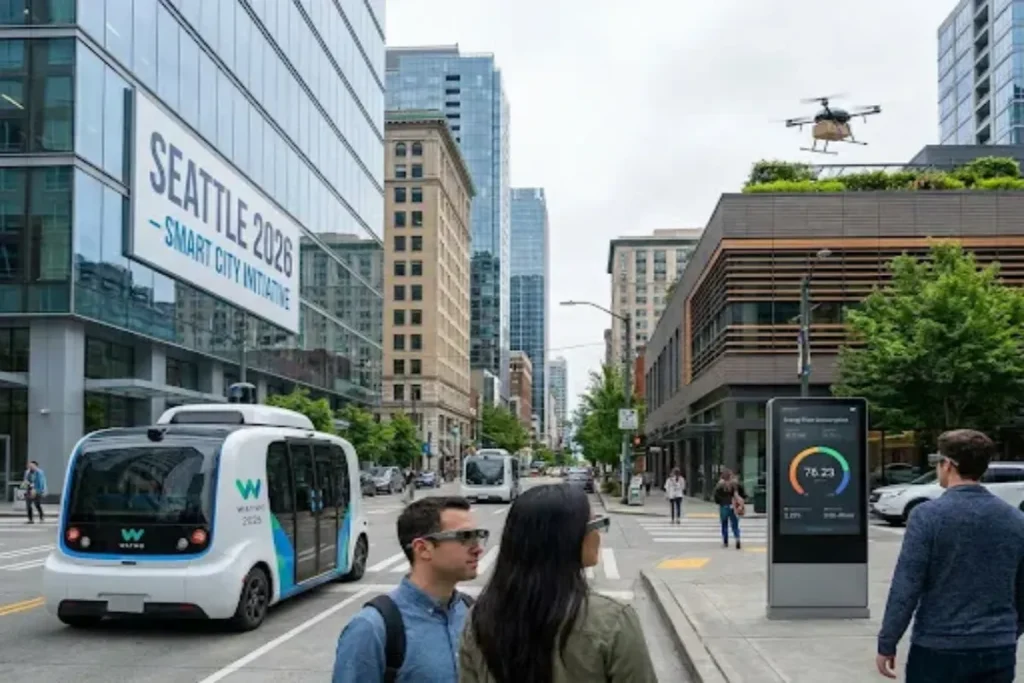
Building Autonomous “Agentic” AI & Multi-Agent Systems requires moving away from single-agent workflows. Single-agent workflows process tasks sequentially through one limited context window. They easily get confused, lose track of the original goal, or hallucinate when the task gets too complex.
Multi-agent architectures change the game by running in parallel. This is known as orchestration.
The Digital Assembly Line
Industry leaders are redesigning their operations to be AI-first by creating “digital assembly lines”. Here is how the orchestration typically flows:
- The Trigger: A human manager defines a high-level goal (e.g., “Analyze our Q3 sales data, compare it to competitor pricing, and generate a localized marketing strategy for Q4”).
- Task Decomposition: The Orchestrator Agent breaks this massive goal into smaller, manageable chunks.
- Routing & Delegation: The Orchestrator routes the data analysis to a Data Agent, the competitor research to a Web-Scraping Agent, and the creative writing to a Marketing Agent.
- Parallel Execution: All agents work simultaneously in their dedicated environments. They pull live data from CRMs, ERP systems, and cloud infrastructure.
- Agent-to-Agent Communication: If the Marketing Agent needs specific numbers to write the copy, it queries the Data Agent directly using open standards like the Model Context Protocol (MCP) or Agent2Agent (A2A) frameworks.
- Validation & Synthesis: A dedicated QA Agent reviews the combined work for accuracy and hallucinations. If errors are found, it sends the work back for revision.
- Output: The final, polished strategy is delivered to the human manager for approval.
The Rise of Visual Workflow Builders
A massive trend driving adoption in 2026 is the shift toward visual workflow builders. In the past, deploying a multi-agent system required data scientists and complex coding. Today, platforms utilize Kanban-style boards where managers can drag and drop agent cards, describe their tasks in plain English, and monitor their execution in real-time. This no-code approach has democratized AI, allowing operational teams to build their own autonomous systems.
The Core Components of an Agentic Ecosystem
To successfully deploy Autonomous “Agentic” AI & Multi-Agent Systems, you need to understand their anatomical makeup. The most robust systems in 2026 share these foundational elements:
1. Goal-Oriented Planning
Traditional AI stops when it hits a roadblock. Agentic AI is designed for “multi-step reasoning.” It creates a dynamic plan and continuously adjusts that plan based on new information.
2. Tool Use (Function Calling)
Agents are no longer trapped in a chat window. Deep integration with enterprise systems allows agents to trigger actions via APIs. They can read Salesforce data, write a Jira ticket, execute a Python script, or send a Slack message—acting exactly as a human employee would.
3. Persistent Memory
Modern agents possess both short-term memory (for the context of the current task) and long-term memory (stored in vector databases). This allows them to recall a user’s preferences, historical business decisions, and past errors, leading to hyper-personalized and highly accurate outputs.
4. Guardrails and Security
With increased autonomy comes the need for increased security. In 2026, agents operate within strict ethical and operational guardrails. If an agent decides it needs to execute a financial transaction or alter a core database, it automatically escalates the decision to a human-in-the-loop.
Key Insight: Notice how increasing the “Task Complexity” slider without adding specialized agents creates bottlenecks in the Orchestrator node. This perfectly visualizes why single-agent workflows fail under enterprise workloads, making multi-agent delegation essential.
Real-World Examples & Applications in 2026
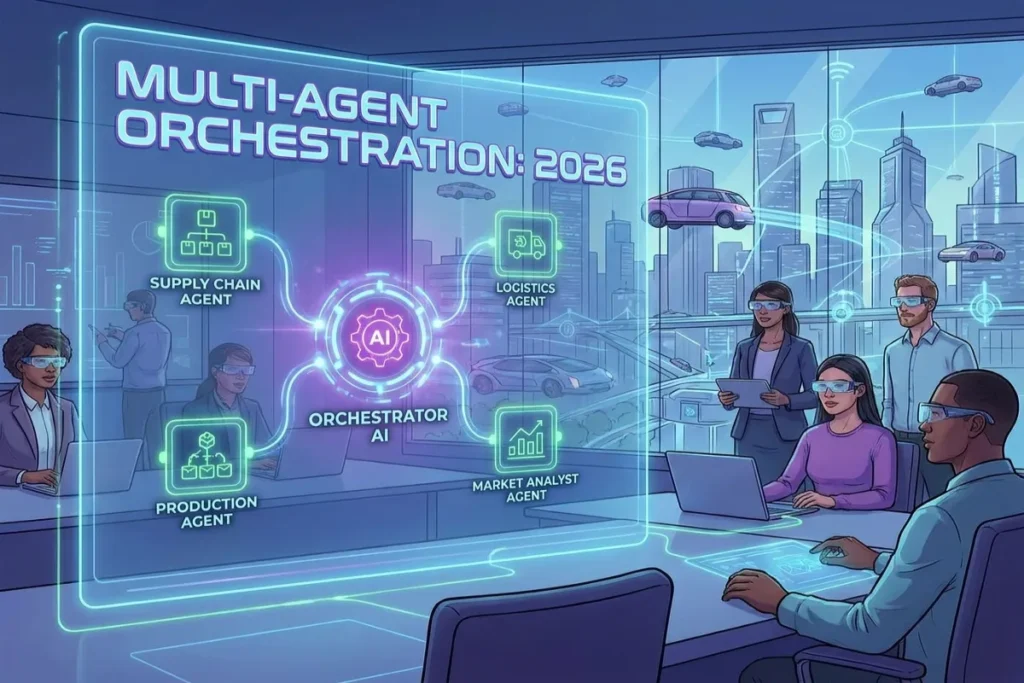
The theoretical benefits of AI are great, but business leaders care about ROI. As of early 2026, approximately 88% of organizations that adopted agentic AI reported a positive return on investment in at least one major use case. Let’s explore how different industries are utilizing these systems.
Software Engineering and DevOps
The coding landscape has been revolutionized. According to Anthropic’s 2026 Agentic Coding Trends Report, developers are moving away from writing every line of code to designing system architectures. Multi-agent systems can now work autonomously for days at a time to build, test, and deploy entire applications.
- The Process: A “Product Manager Agent” writes the spec. A “Frontend Agent” and “Backend Agent” write the code in parallel. A “Security Agent” automatically scans for vulnerabilities before a human ever reviews it.
Customer Service and IT Operations
Customer service is shifting from reactive chatbots to “concierge-level” proactive support. In healthcare, AI agents are successfully handling 87% of patient service interactions end-to-end, managing everything from identity verification to scheduling without human intervention. In IT and HR, agents absorb up to 93% of peak demand before a human service desk is involved.
- The Process: Instead of simply answering a password reset question, an IT Agent identifies the user, securely verifies their identity via a multi-factor authentication API, resets the password in the active directory, and follows up to ensure the user logged in successfully.
Autonomous Threat Detection (Cybersecurity)
Security Operations Centers (SOCs) are notoriously overwhelmed by alert fatigue. Agentic security systems in 2026 don’t just flag threats; they autonomously triage, investigate, and remediate them. They isolate infected endpoints and block malicious IPs instantly, allowing human analysts to focus on high-level threat hunting rather than sifting through false positives.
Actionable Tips for Integrating Agentic AI
Transitioning to Autonomous “Agentic” AI & Multi-Agent Systems requires strategy. You cannot simply flip a switch. Follow these practical tips to ensure a smooth and profitable integration:
- Start with High-Impact, Low-Risk Workflows: Do not attempt to automate your core financial transactions on day one. Begin with internal processes like vendor onboarding, data enrichment, or preliminary code reviews.
- Map the Process, Not Just the Task: Agentic AI thrives on end-to-end workflows. Document exactly how a process moves from Department A to Department B. Build your multi-agent architecture to mirror this real-world flow.
- Define Clear Guardrails Early: Establish strict boundaries. Determine exactly which databases the agents have “read-only” access to and which they have “write” access to. Always require a human-in-the-loop for actions that impact revenue or compliance.
- Embrace Open Standards: Ensure the platforms you choose support frameworks like Model Context Protocol (MCP). This ensures your HR agent can communicate seamlessly with your IT agent, preventing data silos.
- Focus on Transparent Tooling: Use visual kanban-style builders that provide real-time visibility into what the agents are doing. If an agent hallucinates, you need to be able to look at the execution log and trace exactly where the logic failed.
The Rise of the “Manager of Agents”
Perhaps the most profound impact of Autonomous “Agentic” AI & Multi-Agent Systems is on the human workforce. The rapid adoption of these technologies is forcing a massive reskilling effort globally.
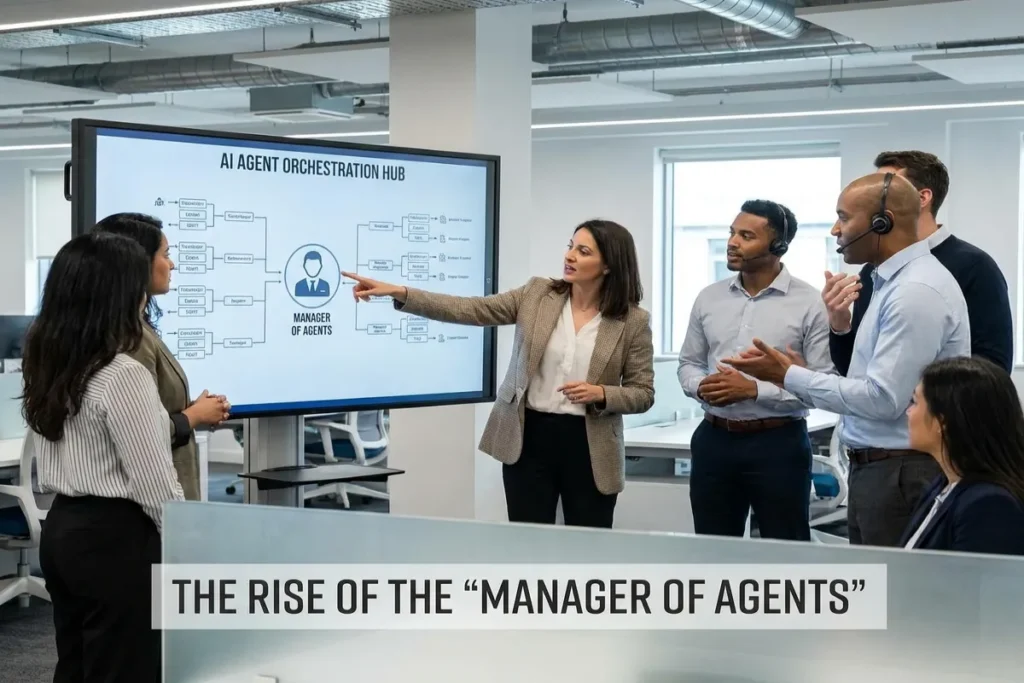
The core job of a knowledge worker is no longer executing repetitive tasks; it is orchestrating agents. Employees are becoming “managers of agents.” They define the strategic goals, delegate tasks to their digital teammates, review the output, and make the final judgment calls.
This shift elevates human potential. By removing the drudgery of data entry, basic coding, and routine customer queries, human employees are freed to focus on what AI cannot do: empathy, complex strategic negotiation, creative innovation, and relationship building. Organizations that invest heavily in AI literacy and train their staff to become “AI Orchestrators” will see the highest long-term value.
Future Trends: What’s Next After 2026?
As we look beyond 2026, the trajectory of multi-agent systems points toward even greater autonomy and cross-company collaboration. Here are a few trends on the horizon:
- B2B Agent Collaboration: We will soon see multi-agent systems coordinating across company boundaries. Your procurement agent will directly negotiate and execute contracts with a supplier’s sales agent, dramatically reducing B2B friction.
- Agentic Commerce: AI agents will monitor inventory levels, track compliance, and autonomously execute purchases within pre-approved budget constraints.
- Edge-Deployed Autonomous Agents: Rather than relying entirely on cloud processing, lightweight agents will be deployed directly on edge devices (like manufacturing sensors or smartphones), making real-time autonomous decisions with zero latency.
Conclusion
The era of prompt engineering and reactive chatbots is officially behind us. In 2026, Autonomous “Agentic” AI & Multi-Agent Systems have fundamentally rewritten the rules of enterprise productivity. By breaking down complex goals, utilizing specialized digital teammates, and integrating deeply with existing software, these systems offer a level of scalability and efficiency that was previously unimaginable.
The businesses that succeed over the next decade will be those that transition their workforce from task-doers to AI orchestrators. They will build digital assembly lines, implement strict but flexible guardrails, and let multi-agent architectures handle the messy reality of daily operations.
Are you ready to build your autonomous workforce? Stay ahead of the curve and explore more cutting-edge AI strategies, tutorials, and tech insights by visiting our homepage at thetekworld.com.
Frequently Asked Questions (FAQs)
1. What is the difference between traditional AI and Agentic AI?
Traditional AI (like early LLMs) is reactive—it waits for a user prompt, generates a single response, and stops. Agentic AI is proactive and autonomous. It can perceive a goal, break it down into actionable steps, use external tools (like APIs and databases), and iteratively work toward a solution without constant human supervision.
2. Why do businesses need Multi-Agent Systems instead of just one smart agent?
A single agent processing complex tasks through one context window is prone to hallucinations, bottlenecks, and losing track of the original goal. Multi-agent systems divide the work among specialized agents (e.g., a coder, a researcher, a reviewer) that work in parallel. This acts like a “digital assembly line,” drastically improving accuracy and speed.
3. Will Agentic AI replace human workers?
No, but it will change their roles. The trend in 2026 is shifting employees into “Managers of Agents”. AI handles routine execution and data processing, while humans focus on setting strategy, reviewing high-stakes outputs, and managing the AI agents. It elevates human work to focus on creativity, judgment, and empathy.
4. How do AI agents communicate with each other?
In modern multi-agent architectures, agents communicate using open protocols like Agent2Agent (A2A) and the Model Context Protocol (MCP). This allows an agent from one department (like Sales) to query data from an agent in another department (like Finance) securely and efficiently, breaking down organizational data silos.
5. Is it safe to give AI agents access to company databases?
Security is a top priority in 2026. Agentic systems operate within strict guardrails. While they may have autonomous “read” access to gather data, critical actions (like moving money, deleting files, or sending external communications) typically require a “human-in-the-loop” to approve the action before the agent executes it.

Comments