We are living in the golden age of artificial intelligence. By 2026, AI is no longer a luxury or an experimental project hidden in the R&D department; it is the beating heart of the modern enterprise. From autonomous supply chain logistics to generative AI copilots drafting global legal contracts, machine learning models are making critical business decisions every single second. But this massive technological leap has introduced a terrifying new reality: our security infrastructure is struggling to keep up.
Traditional firewalls, antivirus software, and perimeter-based security protocols were built to protect static data and structured networks. They are completely blind to the nuanced, logic-based attacks targeting modern machine learning models. If a hacker doesn’t break into your network but instead subtly manipulates the data your AI uses to learn, how do you detect it? How do you stop a threat that looks exactly like normal user behavior?
This is where Next-Gen Cybersecurity for AI steps in. It is not just about using artificial intelligence to catch malware; it is about securing the AI models themselves from a new breed of highly sophisticated, AI-armed threat actors. For IT leaders, Chief Information Security Officers (CISOs), and business executives, understanding and deploying these advanced defensive frameworks is the defining challenge of the decade.
In this comprehensive guide, we will break down the vulnerabilities unique to AI systems, explore the architectural pillars required to defend them, and provide actionable strategies to future-proof your organization.
The 2026 Enterprise Guide to Cloud 3.0 and “Tech Sovereignty”
Table of Contents

The New Threat Landscape: Why Traditional Security Fails
To understand the solution, we must first understand the problem. The attack surface has fundamentally shifted. Threat actors are no longer just looking to steal a database of credit card numbers; they want to manipulate the brain of your organization.
When you deploy a Large Language Model (LLM) or a predictive algorithm, you are introducing entirely new attack vectors that legacy security tools cannot comprehend.
Data Poisoning and Model Manipulation
The most insidious threat to an intelligent system is data poisoning. An AI model is only as good as the data it trains on. If attackers can infiltrate the training pipeline and introduce subtly altered data, they can fundamentally change how the model behaves without triggering a single malware alert.
Imagine a financial fraud detection AI. If a hacker slowly feeds it “poisoned” examples of fraudulent transactions labeled as “safe,” the model will eventually learn to ignore those specific types of fraud. The network wasn’t breached in a traditional sense, but the security logic was bypassed completely.
Prompt Injection and Jailbreaking
With the explosion of generative AI chatbots facing the public, prompt injection has become a critical vulnerability. This occurs when an attacker uses carefully crafted, malicious inputs to override an AI’s original instructions.
For instance, a customer service bot programmed to answer FAQs can be manipulated via prompt injection to reveal sensitive company data, execute unauthorized backend API calls, or generate harmful content. Traditional web application firewalls (WAFs) struggle to block these attacks because the malicious payload is hidden within natural, conversational language.
Model Extraction and IP Theft
Another rising threat in 2026 is model extraction. Competitors or cybercriminals can interact with a public-facing AI API, sending thousands of strategic queries and analyzing the outputs. Over time, they can mathematically reverse-engineer your proprietary algorithm, essentially stealing millions of dollars in R&D without ever breaching your internal servers.
Core Pillars of Next-Gen Cybersecurity for AI
Defending against these novel threats requires a paradigm shift. Implementing Next-Gen Cybersecurity for AI requires a proactive, layered defense strategy that treats the machine learning pipeline as critical infrastructure.
Here are the foundational pillars of a modern AI defense architecture.
1. Adversarial Robustness Testing
You cannot protect a system if you do not know how it breaks. Adversarial robustness testing involves intentionally attacking your own AI models using automated “red team” frameworks.
Before a model is deployed, security teams bombard it with adversarial examples—inputs specifically designed to confuse the neural network. By continuously testing the model against these edge cases during the training phase, you force the AI to become resilient against real-world manipulation.
2. Zero Trust for AI Workloads
Zero Trust (“never trust, always verify”) has been a buzzword for years, but in 2026, it is mandatory for AI environments. AI models require access to vast amounts of sensitive data to function.
A Zero Trust architecture ensures that the AI model itself is treated as a potentially compromised entity. It is granted the absolute minimum permissions required to perform its task (Principle of Least Privilege). Furthermore, every API call made by the AI must be continuously authenticated and authorized. If an AI suddenly tries to access a database it doesn’t normally need, the system blocks the request and alerts the security team.
3. Cryptographic Provenance and Data Integrity
To defeat data poisoning, organizations must guarantee the absolute integrity of their training data. This is achieved through cryptographic provenance—using advanced hashing and decentralized ledgers to create an immutable record of every single data point.
Before a piece of data is allowed into the training pipeline, its digital signature is verified. If the data has been altered by even a single byte in transit, the signature breaks, and the data is quarantined. This ensures your AI is learning only from trusted, verified sources.
Before moving further, it’s crucial to understand your own baseline risk. Use the interactive tool below to simulate how different variables impact your organization’s vulnerability to AI-specific attacks.
Key insight: The most significant risk factor for most enterprises is not the AI model itself, but the lack of governance over the data flowing into it. Securing the pipeline is just as important as securing the application.
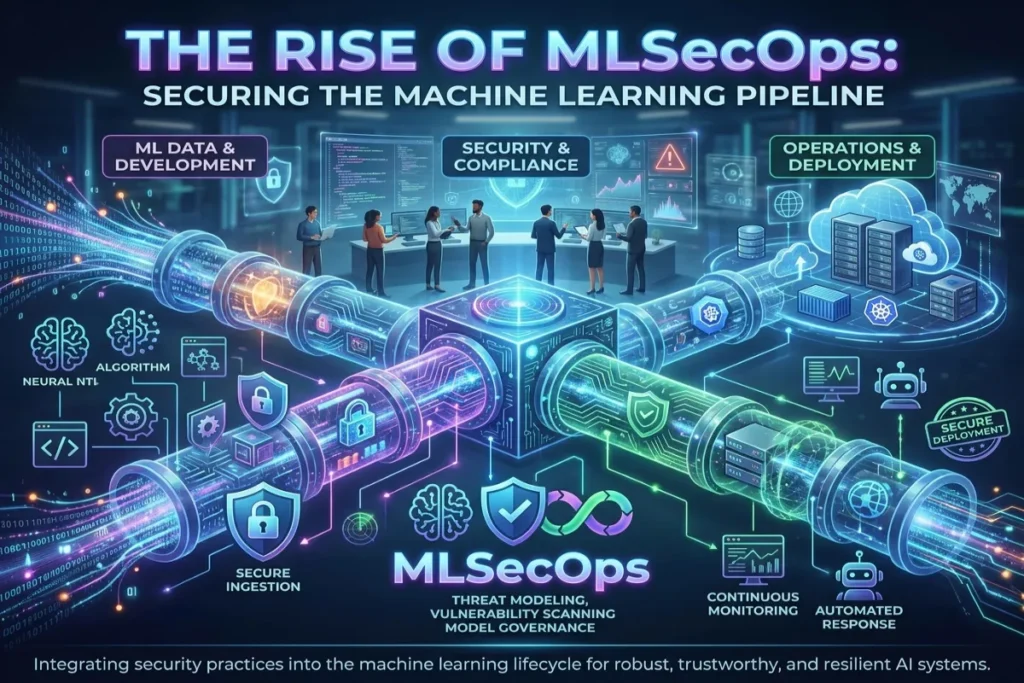
The Rise of MLSecOps: Securing the Machine Learning Pipeline
In the past, we had DevOps. Then, as security became a priority, we shifted to DevSecOps. Today, the standard is MLSecOps (Machine Learning Security Operations).
MLSecOps integrates security directly into the machine learning lifecycle, from initial data gathering to continuous monitoring post-deployment. It breaks down the silos between data scientists, who want models to be accurate and fast, and security engineers, who want models to be safe and resilient.
Continuous Model Monitoring
An AI model’s behavior can “drift” over time as it ingests new data, making it vulnerable to new types of attacks. MLSecOps mandates real-time, continuous monitoring of deployed models.
Security operations centers (SOCs) in 2026 are equipped with specialized AI dashboards that don’t just track network traffic, but monitor the statistical outputs of machine learning models. If an AI’s confidence score on specific tasks drops suddenly, or if it begins producing wildly abnormal outputs, automated tripwires freeze the model’s access to the network.
Automated Model Rollbacks
When a traditional software application crashes, you roll back to the previous version. MLSecOps applies this same logic to AI. If a model is found to be poisoned or behaving maliciously due to a prompt injection attack, the infrastructure automatically swaps it out for a known, clean, older version of the model, ensuring zero downtime for the business while the security team investigates the anomaly.
Practical Examples: AI Cybersecurity in Action
How are industry leaders actually applying these concepts today? Let’s look at practical implementations of Next-Gen Cybersecurity for AI across major sectors.
Financial Services: Thwarting Algorithmic Fraud
A top-tier global bank deployed a generative AI assistant to help high-net-worth clients manage their portfolios. To protect the AI from financial manipulation, the bank implemented a strict LLM Firewall.
This specialized firewall sits between the user and the AI. It uses a secondary, smaller AI model to scan all incoming user prompts for malicious intent, logic traps, or jailbreak attempts. If the secondary AI detects an attack, it neutralizes the prompt before it ever reaches the primary financial AI. This dual-model architecture has reduced successful prompt injections by 99.8%.
Healthcare: Securing Predictive Diagnostics
A network of hospitals uses machine learning to predict patient deterioration based on real-time biometric data. Because data poisoning could literally cost lives, the hospital network employs strict federated learning combined with cryptographic provenance.
Instead of pooling all patient data into one vulnerable central server, the AI model travels to the local hospital servers to train on the data there. The raw, highly sensitive patient data never leaves the local environment, dramatically shrinking the attack surface and making large-scale data poisoning virtually impossible.
E-Commerce: Preventing API Abuse
An international retail giant relies on AI for dynamic pricing and inventory management. Competitors began using automated bots to ping the AI’s API, attempting to reverse-engineer the pricing algorithm (model extraction).
The retailer implemented behavioral rate limiting. Instead of just looking at IP addresses, their security system analyzes the intent of the API calls. When the system detects a pattern of queries designed to map the algorithm’s boundaries rather than make legitimate purchases, it seamlessly feeds the attacker randomized, fake pricing data, effectively poisoning the attacker’s stolen model.

Actionable Tips for IT Leaders in 2026
Migrating to a robust AI security posture can feel overwhelming. However, by taking methodical, strategic steps, you can significantly reduce your enterprise’s risk profile. Here are highly actionable tips you can implement this quarter.
- Conduct an AI Asset Inventory: You cannot protect what you do not know exists. In 2026, “Shadow AI”—where employees use unauthorized, third-party AI tools—is rampant. Run a comprehensive audit to discover every AI model, API, and dataset actively used in your organization.
- Establish an AI Red Team: Hire or train a specialized group of ethical hackers focused entirely on adversarial machine learning. Task them with actively trying to trick, poison, and break your deployed models on a continuous basis.
- Implement Input Sanitization for LLMs: If your company uses public-facing chatbots, immediately deploy an LLM-specific firewall. Treat every user prompt as untrusted input. Use semantic filters to block prompts that attempt to alter the bot’s system instructions.
- Adopt MLSecOps Frameworks: Mandate that your data science teams and your cybersecurity teams share the same pipeline. Require security sign-offs at the dataset curation stage, the training stage, and the deployment stage.
- Audit Third-Party AI Vendors: If you are buying AI solutions off the shelf, demand transparency. Ask vendors for their adversarial testing results, their data provenance guarantees, and their incident response plans for model poisoning. Treat an AI vendor’s security posture with the same scrutiny as a cloud infrastructure provider.
Conclusion: Securing the Future
The integration of artificial intelligence into the enterprise is irreversible. It drives unprecedented efficiency, innovation, and profitability. But the same technology that empowers your business also empowers cybercriminals. The days of relying on traditional network defenses are over.
Adopting Next-Gen Cybersecurity for AI is no longer a forward-looking strategy; it is a fundamental requirement for operational survival. By understanding the unique vulnerabilities of machine learning models, implementing MLSecOps, and demanding zero-trust architectures for your data pipelines, you can build an intelligent enterprise that is as secure as it is innovative.
Do not wait for a catastrophic data poisoning event to rethink your security posture. The time to secure your AI is right now.
Ready to future-proof your digital infrastructure? Explore more cutting-edge insights, architecture breakdowns, and expert guides at thetekworld.com and stay one step ahead of tomorrow’s threats.
Frequently Asked Questions (FAQs)
1. What is the difference between traditional cybersecurity and AI cybersecurity?
Traditional cybersecurity focuses on protecting networks, endpoints, and data from unauthorized access or malware. AI cybersecurity focuses on protecting the logic, training data, and outputs of machine learning models from manipulation, such as data poisoning or prompt injection, which bypass traditional firewalls.
2. What is data poisoning?
Data poisoning is a cyberattack where malicious actors intentionally alter or introduce corrupted data into an AI’s training set. This causes the AI to learn incorrect behaviors or create deliberate blind spots, compromising its decision-making abilities without triggering traditional malware alerts.
3. How does MLSecOps differ from DevSecOps?
DevSecOps integrates security into traditional software development. MLSecOps (Machine Learning Security Operations) specifically integrates security into the lifecycle of artificial intelligence. It focuses on securing training datasets, preventing model drift, testing for adversarial robustness, and continuously monitoring algorithmic outputs.
4. Can firewalls protect Large Language Models (LLMs)?
Traditional web application firewalls (WAFs) struggle to protect LLMs because malicious prompts look like normal conversational text. However, specialized “LLM Firewalls” are now available. These use secondary AI models to analyze the semantic intent of a prompt and block injection attacks before they reach the main AI.
5. Why is model extraction dangerous?
Model extraction allows an attacker to steal your proprietary AI algorithm without breaching your servers. By sending thousands of strategic queries to your public API and analyzing the answers, attackers can map out the logic and rebuild a replica of your model, resulting in severe intellectual property theft

Comments