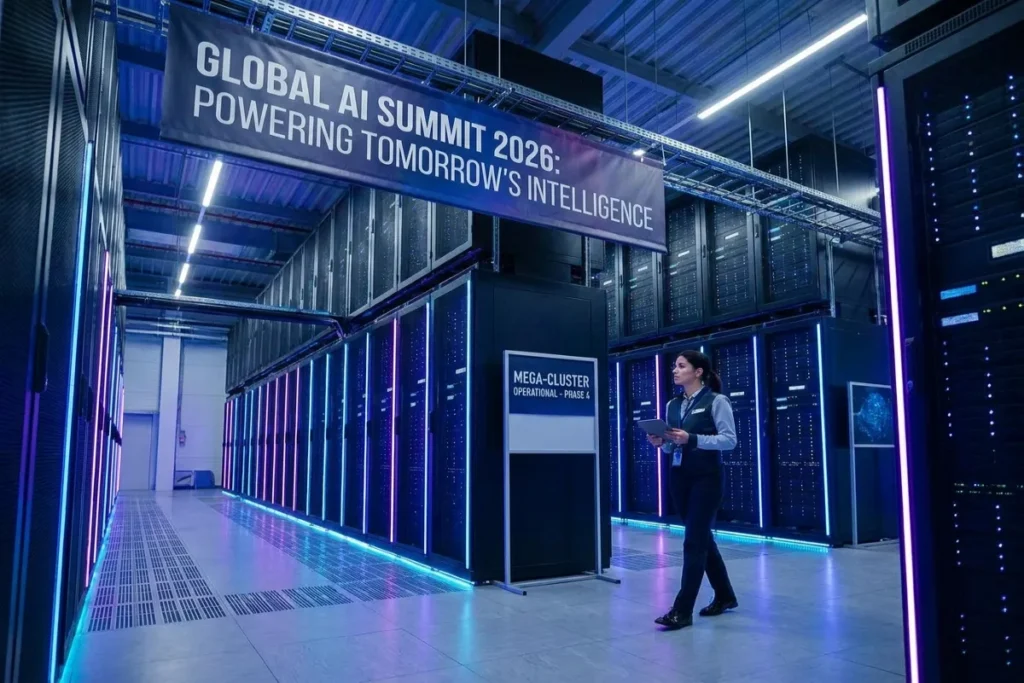
The world of technology moves in tectonic shifts. A decade ago, the conversation was entirely dominated by the migration to cloud computing and the virtualization of enterprise software. In 2026, the technology landscape has pivoted drastically. We are no longer simply renting virtual machines; we are constructing monolithic, synchronous hardware engines capable of simulating advanced scientific models and training Artificial General Intelligence (AGI). For IT leaders, data center engineers, and enterprise architects, understanding this transition is no longer optional—it is critical for survival in a highly competitive digital economy. Enter The Boom in AI Supercomputing.
This massive acceleration in hardware infrastructure is actively solving the primary bottleneck of modern software: compute scarcity. As artificial intelligence models scale aggressively from billions to trillions of parameters, traditional scattered server farms are failing to provide the required network bandwidth and localized processing power. To remain competitive, tech giants and enterprises alike must adapt to a reality where supercomputers operate as a single, unified “brain.”
In this comprehensive, professional guide, we will unpack the driving forces behind this explosive growth, examine the world’s most powerful AI systems, dissect the severe physical limitations of power and cooling, and provide highly actionable strategies to help your enterprise thrive in this new era of high-performance computing.
The 2026 Reality: Why AI is “Eating” Software Development
Table of Contents
What is Driving The Boom in AI Supercomputing?
The shift toward AI supercomputing did not happen in a vacuum. It is a direct response to the insatiable resource demands of frontier AI models. In the early 2020s, generative AI amazed the world with basic language and image synthesis. Today, models are multimodal, capable of real-time video generation, autonomous multi-agent reasoning, and complex genomic sequencing. Delivering these capabilities requires a fundamentally different computing architecture.
- The Trillion-Parameter Threshold: Modern AI systems require tens of thousands of GPUs working in perfect synchrony to adjust trillions of weights and biases during the massive training phase. A standard cloud network experiences far too much latency for this task. The data must flow instantly between processors without bottlenecks.
- Synchronous Computing Needs: Unlike web hosting, where millions of independent users access different, isolated servers asynchronously, AI training requires a “scale-up” architecture. If one GPU in a 100,000-GPU cluster stalls or drops a packet, the entire training process can halt. This absolute requirement necessitates specialized, high-bandwidth interconnects like InfiniBand or ultra-fast, custom Ethernet topologies.
- The Pursuit of AGI: Technology conglomerates are currently locked in an unprecedented arms race to achieve AGI. This requires ungodly amounts of processing power, prompting companies to bypass standard cloud providers and build custom, purpose-built mega-clusters tailored precisely to their algorithmic designs.
Traditional Data Centers vs. AI Supercomputers
To truly grasp the magnitude of this evolution, one must understand how an AI supercomputer differs from a traditional enterprise data center. A standard data center is built for high availability, redundancy, and distributed workloads—think hosting thousands of e-commerce websites or managing corporate email servers. Conversely, an AI supercomputer is a single, unified machine built for maximum throughput on a single mathematical workload.
| Feature | Traditional Data Center | AI Supercomputer |
| Primary Workload | Distributed, asynchronous (Web servers, databases) | Unified, synchronous (AI model training, simulation) |
| Power Density | 10 to 15 kW per rack | 100 to 150+ kW per rack |
| Cooling Method | Computer Room Air Conditioning (CRAC) | Direct-to-chip liquid cooling and immersion cooling |
| Networking Fabric | Standard TCP/IP Ethernet | High-speed InfiniBand or custom NVLink topologies |
| Storage Architecture | Standard NAS / SAN (Network Attached Storage) | High-performance parallel file systems (e.g., Lustre) |
To visualize how these architectural differences impact operational costs, power consumption, and processing performance (measured in FLOPS), use our interactive calculator below to compare traditional infrastructure against modern AI mega-clusters.
The Titans of 2026: Inside the World’s Largest AI Supercomputers
The landscape of high-performance computing in 2026 is defined by multi-billion-dollar megaprojects. These facilities are so monumentally large that they require the energy output of entire power plants just to turn on the lights and spin up the servers.
Project Stargate: The $500 Billion Megaproject
Perhaps the most ambitious infrastructure initiative in modern history is Project Stargate. Backed by heavyweights including OpenAI, SoftBank, Oracle, and MGX, this joint venture plans to deploy up to $500 billion by 2029 to secure American AI dominance. Stargate encompasses multiple sprawling sites across the United States, targeting an astounding 7 gigawatts of planned power capacity. It represents a fundamental shift in capital expenditure, treating AI data centers not merely as corporate assets, but as critical national infrastructure akin to the interstate highway system.
xAI’s Colossus: The Memphis Monster
In Memphis, Tennessee, Elon Musk’s xAI operates the “Colossus” cluster, which stands as a towering testament to the speed of modern AI deployments. Originally coming online with a staggering 100,000 GPUs, it rapidly scaled to over 200,000 highly interconnected H100 processors. Moving into 2026, the facility is expanding further with next-generation GB200-class processors, drawing on the order of 1 gigawatt of compute capacity supported by a dedicated 1.2 GW simple-cycle power plant. Colossus is utilized not only to train the Grok AI model but is also leased to competitors like Anthropic and Google for close to a billion dollars per month.
NVIDIA Vera Rubin Platform
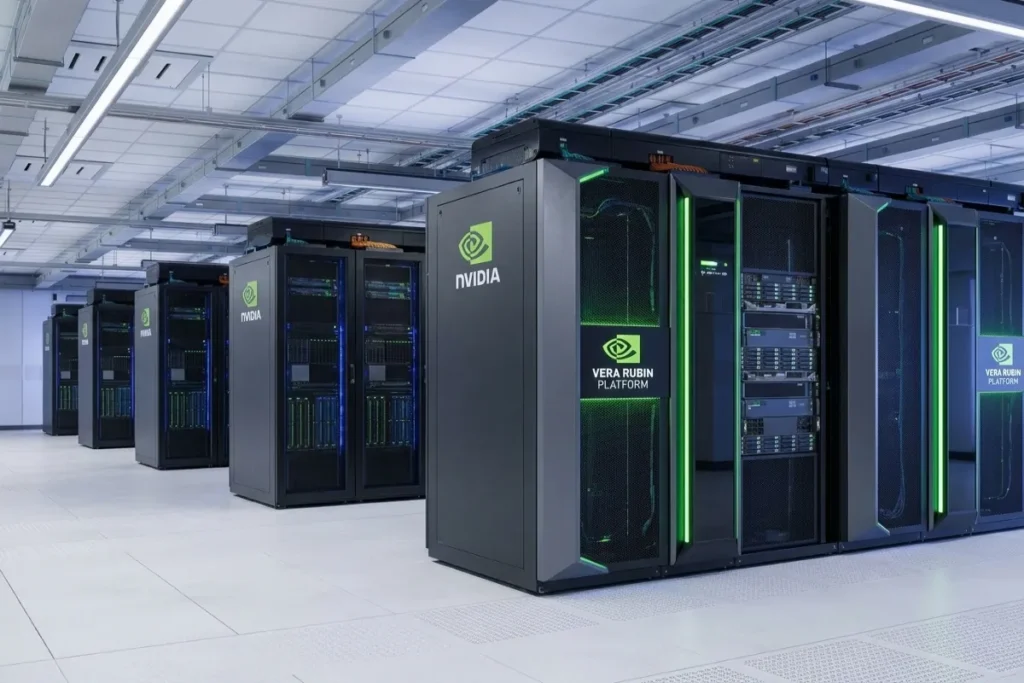
On the hardware provider side, NVIDIA’s Vera Rubin architecture has redefined what a single physical rack can achieve. Designed heavily for scientific discovery and advanced computational research, the platform delivers 7 exaflops of AI compute and 5 petaflops of native double-precision (FP64) performance per rack. This capability allows national laboratories and industrial enterprises to run high-fidelity climate models, computational fluid dynamics, and quantum chemistry simulations previously thought entirely impossible.
The physical footprint of these mega-clusters stretches across hundreds of thousands of square feet, housing thousands of tightly packed server racks interconnected by miles of high-speed fiber optic cables.
The Physical Bottlenecks: Power, Cooling, and Land
Building an AI supercomputer is no longer just a computer science problem; it is a complex thermodynamics and civil engineering problem. The speed of AI advancement is currently constrained by the physical world.
The Insatiable Thirst for Power
AI supercomputing facilities require gigawatt-level power agreements. To put this in perspective, a single 1-gigawatt data center consumes as much electricity as a medium-sized metropolitan city. Tech giants are increasingly partnering with nuclear energy providers, investing heavily in Small Modular Reactors (SMRs), and funding dedicated natural gas peaker plants just to ensure their clusters remain energized. The limitations on AI progression in 2026 are not dictated by silicon manufacturing, but by the electrical grid’s ability to supply continuous, uninterrupted megawatts of power.
The Shift to Liquid Cooling
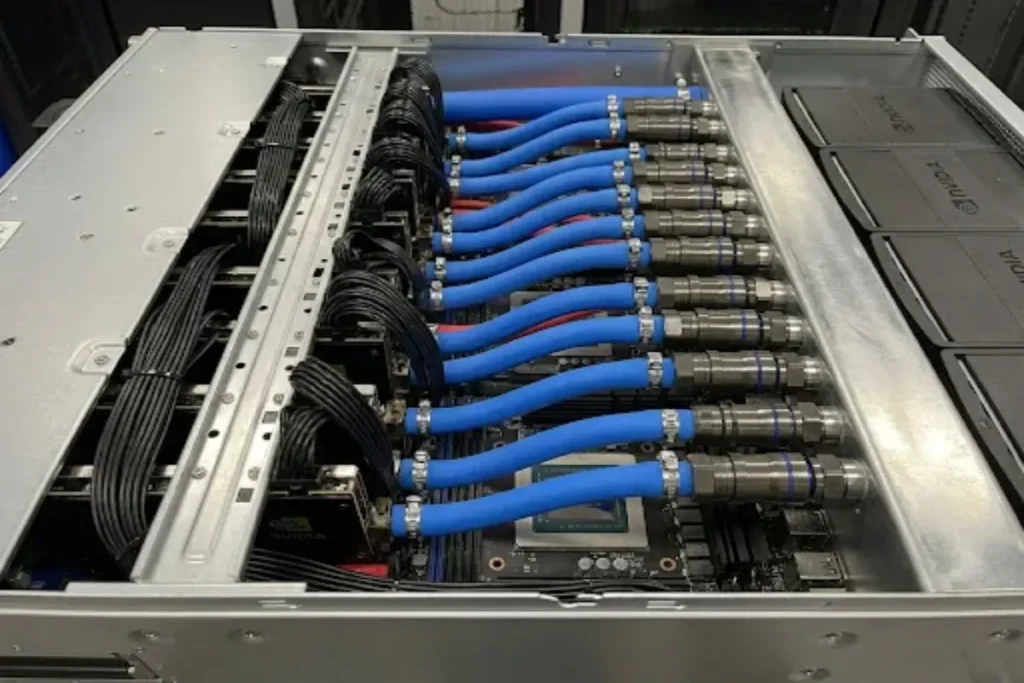
Because dense AI server racks can draw well over 100 kW to 150 kW of power, traditional air cooling is physically incapable of dissipating the heat fast enough. The industry has firmly transitioned to direct-to-chip liquid cooling and two-phase immersion cooling. In these setups, dielectric fluids flow directly over the GPUs and CPUs to extract heat efficiently before it can degrade hardware performance.
To prevent thermal throttling and hardware failure, modern AI supercomputers rely heavily on intricate liquid cooling manifolds built directly into the server chassis, forever changing data center plumbing and architecture.
The Economic and Geopolitical Impact
The sheer scale of The Boom in AI Supercomputing is fundamentally rewriting the economics of global technology. The global AI supercomputer market, valued at roughly $3.42 billion in 2025, is on an explosive trajectory to reach nearly $34 billion by 2035, growing at an unprecedented Compound Annual Growth Rate (CAGR) of nearly 26%.
This massive economic surge has deep geopolitical implications. Governments worldwide recognize that sovereign AI capabilities are a matter of absolute national security. Tariffs on critical hardware components—like GPUs, Tensor Processing Units (TPUs), and High-Bandwidth Memory (HBM)—have forced regions in North America and Europe to invest heavily in local manufacturing and resilient supply chains. Consequently, AI supercomputers are not just lucrative business assets; they are strategic national reserves meant to secure a country’s economic future.
Actionable Tips: How Enterprises Can Navigate the AI Supercomputing Era
You do not need a $100 billion budget or a dedicated nuclear reactor to benefit from this technological revolution. Here are practical, actionable ways your organization can adapt to the 2026 supercomputing landscape:
- Embrace Cloud-Based AI Clusters: Instead of attempting to build a prohibitively expensive on-premises supercomputer, leverage cloud service providers that offer reserved AI supercomputing instances. This allows you to rent fractions of a mega-cluster on demand without the crippling capital expenditure.
- Optimize Your AI Workloads Strategically: Not every task requires an exascale supercomputer. Use smaller, quantized models (like 8-billion parameter models) for edge inference and basic customer service bots. Reserve your expensive, high-performance compute time strictly for massive model training and complex data fine-tuning.
- Upgrade Your Networking Infrastructure: If you are building a hybrid or small on-premises AI environment, do not bottleneck your expensive GPUs with standard networking. Invest in high-bandwidth, low-latency fabrics like InfiniBand or 800G Ethernet to ensure synchronous data flow between your processing units.
- Prepare for the Liquid Cooling Transition: If you are retrofitting an existing data center to house dense AI racks, you must upgrade your facility’s mechanical plumbing. Partner with HVAC and engineering firms early to map out liquid cooling manifolds, heat exchangers, and reinforced floor loading to handle the massive weight of liquid-filled racks.
- Focus on Data Proximity: An AI supercomputer is useless if it is constantly starved of data. Ensure your high-performance storage arrays (utilizing parallel file systems) are physically and architecturally close to your compute clusters to minimize latency during the training process.
Conclusion
The rapid transition from generalized, asynchronous cloud environments to specialized, highly synchronized compute clusters is the defining characteristic of this decade’s enterprise tech landscape. The Boom in AI Supercomputing represents the most significant infrastructure build-out since the creation of the internet itself. From the gigawatt-hungry halls of Project Stargate to the densely packed, liquid-cooled racks of NVIDIA’s Vera Rubin scientific systems, humanity is currently forging the exact engines that will solve our most complex scientific, medical, and societal challenges.
To thrive in this environment, IT leaders must deeply understand the unique thermal, networking, and power demands of this new hardware paradigm. By embracing cloud-based AI clusters, upgrading facility cooling, and optimizing workload deployment, modern enterprises can harness the power of these digital titans without collapsing under their immense operational weight.
Ready to future-proof your IT infrastructure? Dive deeper into the technologies shaping our world and discover cutting-edge strategies at thetekworld.com.
Frequently Asked Questions (FAQ)
1. How is an AI supercomputer fundamentally different from a traditional supercomputer?
While traditional supercomputers are often built for high-precision, double-precision floating-point (FP64) math used in physics and weather simulations, AI supercomputers are heavily optimized for lower-precision math (like FP16, FP8, or even FP4). This allows them to rapidly process the massive matrix multiplications required for neural network training at significantly higher speeds.
2. Why are AI data centers moving away from traditional air cooling?
Modern AI processors generate an immense amount of concentrated heat. A single rack packed tightly with GPUs can consume upwards of 100 kW to 150 kW of power. Ambient air simply lacks the thermal density to carry that much heat away quickly enough, making direct-to-chip liquid cooling and immersion techniques a physical necessity to prevent the chips from melting.
3. What is the biggest limitation to building more AI supercomputers today?
In 2026, the primary bottleneck is access to commercial power and land. Securing a 1-gigawatt power agreement requires years of negotiating with energy grids, building dedicated high-voltage substations, and occasionally constructing natural gas or small modular nuclear reactors to ensure a perfectly stable energy supply.
4. Can small and medium-sized businesses (SMBs) utilize AI supercomputers?
Yes, primarily through cloud-based AI service providers. Companies like AWS, Microsoft Azure, and specialized AI clouds rent out partitioned access to these mega-clusters. This “Platform as a Service” model allows smaller businesses to train their proprietary models without the need to purchase or maintain the physical hardware themselves.

Comments