For the past few years, artificial intelligence has felt like a brilliant but entirely dependent assistant. Generative AI tools could draft emails, write code snippets, and summarize vast amounts of data, but they inherently lacked initiative. They sat idle until a human provided a prompt, and they stopped working the moment their output was generated. Business leaders quickly realized that while these tools boosted individual productivity, they did little to solve the core bottlenecks of complex, multi-step enterprise operations.
In 2026, that paradigm has officially shattered. We have crossed the threshold into The Era of Autonomous “Agentic” AI.
Instead of waiting for instructions, agentic AI systems are designed to operate autonomously guided by predefined business goals. They can perceive their environment, break down complex problems, orchestrate multi-step workflows, trigger actions across disparate enterprise applications, and learn from their outcomes—all with limited human supervision. Gartner predicts that by the end of 2026, 40% of enterprise applications will embed task-specific AI agents, a massive leap from less than 5% just a year prior.
Whether you are a CIO mapping out your digital infrastructure, an operations manager looking to scale your workforce, or an IT professional eager to understand the next wave of automation, this comprehensive guide will break down how autonomous agents work, how to implement them safely, and why they are actively reshaping the enterprise software landscape.
Monitor Arms: The Ultimate 2026 Masterclass on Ergonomics & Desk Space
Table of Contents
What is Agentic AI? The Shift from Prompts to Autonomous Action
To understand the magnitude of this shift, we must clearly define what separates an “agent” from a traditional large language model (LLM) or a standard automation script.
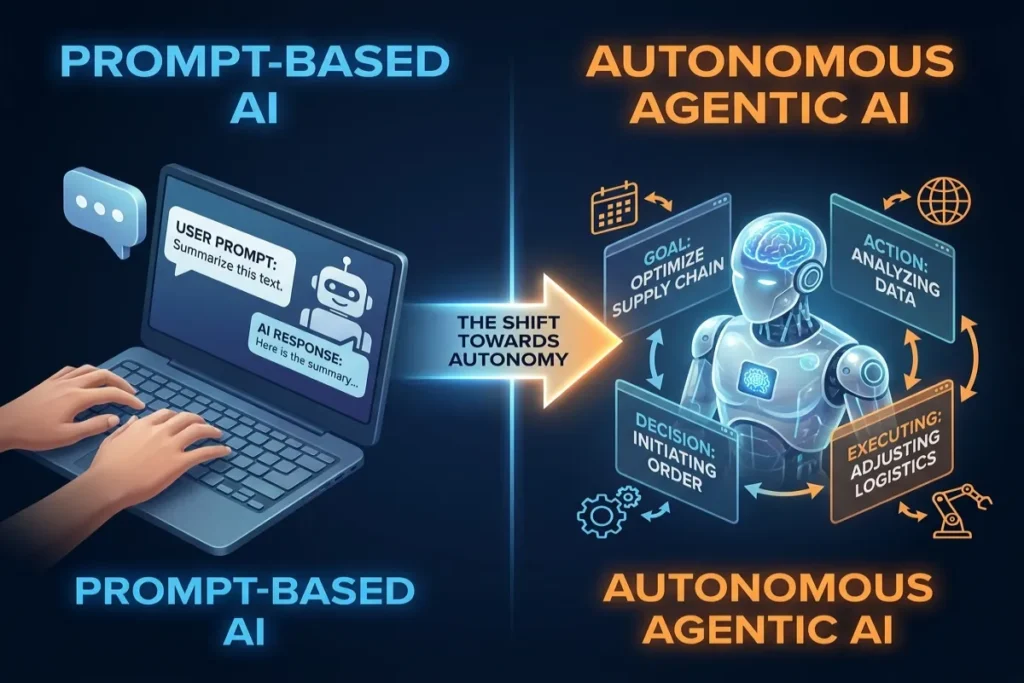
A standard chatbot is reactive. You ask it a question, it searches its training data or a connected database, and it provides an answer. Traditional Robotic Process Automation (RPA) is also rigid; it follows a strict “if-this-then-that” ruleset and breaks down entirely if a website UI changes or an unexpected variable appears.
Agentic AI operates differently. It possesses the ability to reason, plan, and adapt dynamically. An AI agent is given an objective—such as, “Analyze our Q3 vendor invoices, identify any billing discrepancies against our ERP contracts, and draft dispute emails for any overcharges.”
To accomplish this, the agentic system will autonomously:
- Formulate a step-by-step execution plan.
- Connect to the company’s email and cloud storage to retrieve the invoices.
- Query the ERP system (like SAP or Oracle) to cross-reference contracted rates.
- Identify mathematical anomalies or billing errors.
- Generate a targeted email and stage it in a human review queue.
This level of goal-oriented behavior means software is evolving from a passive tool into an active participant in your digital workforce.
The 5-Layer Architecture of Modern AI Agents
To achieve true autonomy, enterprise AI agents in 2026 are built upon a distinct five-layer architecture:
- Intelligence (The LLM Foundation): The cognitive engine driving the agent, typically a frontier model that processes natural language and performs base-level logical deduction.
- Decision (Reasoning and Planning): The layer where the agent breaks large goals into sequential steps, utilizing frameworks like Chain-of-Thought or Tree-of-Thoughts to evaluate different approaches before acting.
- Execution (Integrations and Tools): The APIs and permissions allowing the agent to interact with the outside world—pulling data from PostgreSQL databases, updating Salesforce, or triggering Stripe refunds.
- Action (Orchestration): The real-time management of the workflow, determining what to do if an API call fails or if a piece of information is missing.
- Learned (Memory and Observability): The stateful memory systems (often utilizing vector databases) that allow the agent to recall past interactions, avoid repeating mistakes, and maintain context across long-running sessions.
Multi-Agent Systems: Building the Digital Workforce
One of the most profound realizations of 2026 is that a single, omnipotent AI agent is rarely the best solution for complex enterprise workflows. Instead, the industry has aggressively shifted toward Multi-Agent Collaboration Systems.
Just as a human company operates through specialized departments, organizations are now deploying specialized AI agents that coordinate with one another to complete massive organizational tasks.
How Multi-Agent Orchestration Works
Imagine a software development pipeline. In a multi-agent framework, you do not just have one “coding bot.” Instead, you have an entire digital team:
- The Product Manager Agent: Reads user feedback and translates it into technical requirements and Jira tickets.
- The Developer Agent: Writes the code to fulfill those specific tickets.
- The QA Agent: Autonomously tests the code, identifies bugs, and sends it back to the Developer Agent for revision.
- The DevOps Agent: Deploys the finalized, tested code to the staging server.
These agents converse with one another, challenge each other’s outputs, and iterate until the final product meets the predefined standards.
The Frameworks Powering the Revolution
Navigating The Era of Autonomous “Agentic” AI requires the right infrastructure. In 2026, several open-source and enterprise frameworks have become the industry standard for building these multi-agent environments:
- LangGraph: Built on top of the LangChain ecosystem, LangGraph focuses on building highly controllable, stateful workflows. It allows developers to map out complex, cyclical agent behaviors where agents can loop back and correct their own errors based on environmental feedback.
- CrewAI: Specifically designed for role-playing multi-agent systems, CrewAI allows businesses to define agents with distinct personalities, backgrounds, and toolsets, making it incredibly easy to spin up a digital marketing team or a financial analysis squad.
- AutoGen: A highly layered abstraction framework that excels at multi-agent conversational patterns. It allows developers to create systems where multiple agents debate solutions to arrive at highly optimized, mathematically sound conclusions.

The Death of Application Sprawl: Shrinking Software Licenses
One of the most unexpected economic trends in 2026 is how agentic AI is disrupting the traditional Software as a Service (SaaS) business model.
For the last decade, companies accumulated massive application sprawl. They bought seats for CRM platforms, project management tools, HR dashboards, and ERP systems. However, humans were required to log into these visual dashboards, click buttons, and manually port data from one screen to another.
To succeed in The Era of Autonomous “Agentic” AI, companies are realizing they no longer need 500 human employees logging into a visual software interface. If an AI agent can query an underlying database directly via API to retrieve customer history, update deal stages, and generate sales forecasts, the expensive visual layer of the software becomes obsolete for most of the staff.
This is leading to a massive reduction in per-seat software licenses. Enterprises are maintaining core databases but replacing human dashboard interaction with Agentic Suites that sit on top of the data. Traditional SaaS platforms that fail to adapt their pricing models from “per-seat” to “per-API-call” or “outcome-based” pricing are rapidly losing enterprise market share.
Practical Examples: Where Agentic AI Wins in 2026
The theoretical capabilities of AI are fascinating, but the ROI is what drives adoption. Here is how leading organizations are deploying autonomous systems today to drive measurable impact.
1. Supply Chain and Resource Optimization
A global logistics company utilizes agentic AI to autonomously manage supply chain disruptions. When a major weather event delays a cargo ship, the AI system doesn’t just send an alert to a human manager. Instead, the agent actively checks alternative shipping routes, calculates the cost difference of air freight vs. ground transport, autonomously re-books the necessary transit, and automatically updates the delivery ETAs in the customer-facing portal.
2. Autonomous Threat Detection and Cybersecurity
In cybersecurity, milliseconds matter. Traditional AI could flag suspicious network activity, but a human analyst still had to investigate and respond. Modern autonomous security agents act as an active digital immune system. If they detect an anomaly (like an unauthorized database export), the agent autonomously isolates the affected server, revokes the compromised user credentials, patches the vulnerability, and compiles a forensic incident report for human review—all in under 30 seconds.
3. Hyper-Personalized Customer Success
Customer service agents are moving beyond pre-scripted chatbots. When a customer emails asking for a refund because a product arrived damaged, the agentic system reads the email, verifies the tracking data, processes the image of the damaged product using computer vision, authorizes the refund through the payment gateway, and triggers a replacement order in the fulfillment center. The entire loop is closed instantly.
Actionable Tips for Deploying Your First AI Agent
Moving from traditional workflows to agentic automation requires a strategic, phased approach. Do not attempt to automate your entire business in a single weekend. Follow these actionable steps to ensure a successful, secure deployment.
Step 1: Start with High-Impact, Low-Risk Workflows
Do not put an autonomous agent in charge of your company’s payroll or final legal contracts on day one. Start by identifying processes that are highly repetitive, data-heavy, but have a low cost of failure. Practical Example: Use an agent to automate internal IT helpdesk ticket triage or vendor invoice data extraction.
Step 2: Implement “Human-in-the-Loop” Checkpoints
Autonomy does not mean abandonment. When first deploying an agent, design the workflow so the agent does 95% of the heavy lifting, but pauses to ask for human approval before executing irreversible actions. For example, the agent can draft the client proposal, calculate the discounts, and stage the email, but a human account manager must click “Approve” before it sends. As confidence in the system grows, you can gradually remove the checkpoints.
Step 3: Upgrade Your Data Infrastructure
Agentic AI is only as smart as the data it can access. Traditional relational databases are often too rigid for fluid AI reasoning. In 2026, investing in robust vector databases (like Pinecone, Milvus, or Qdrant) and ensuring real-time data ingestion pipelines (like Apache Kafka) are critical. Agents need to access unstructured data—like past chat logs, PDFs, and emails—at lightning speed to maintain context.
Step 4: Define Strict Permission Boundaries
Treat an AI agent like a newly hired contractor. You would not give a day-one contractor master admin access to your entire server. Use the Principle of Least Privilege. Give your AI agents access only to the specific APIs, folders, and tools necessary to complete their assigned tasks. If an agent is designed to read marketing data, explicitly block its API access to the HR employee database.
Calculating the Impact: The Agentic ROI Strategy
Understanding the Total Cost of Ownership (TCO) for agentic systems is vital. Costs have shifted from human labor and fixed software licenses to dynamic compute resources and API token usage.

Navigating Security, Governance, and Trust
The greatest barrier to scaling autonomous AI is trust. How do you govern a system that thinks and acts for itself?
Security in The Era of Autonomous “Agentic” AI requires a fundamental shift from post-event auditing to real-time observability. Because agents operate at machine speed, waiting for a monthly audit is too late. Enterprises must implement rigorous governance frameworks before scaling:
- Immutable Tracing and Logging: Every decision, API call, and reasoning step taken by an agent must be logged in an immutable ledger. If an agent makes a mistake, engineers must be able to trace exactly which piece of data led to the faulty conclusion.
- Combating Prompt Injection: Agents connected to external inputs (like reading customer emails) are vulnerable to adversarial prompt injection. Malicious actors can hide instructions in invisible text within an email, commanding the agent to export confidential data. Robust sanitization layers and secondary “security-check agents” are required to screen inputs before they reach the execution agent.
- SOC 2 Type II Compliance for AI: In 2026, regulatory bodies demand that AI actions be attributable to a specific authorized digital identity. Access logs must be retained, and changes to the agent’s core prompts must go through strict version control and change management protocols.
Elevate Your Business with The Tek World
The transition to autonomous enterprise operations is no longer a distant theoretical concept; it is the present reality. Organizations that successfully navigate the shift from reactive software to proactive, goal-oriented digital workforces will achieve unparalleled operational efficiency, massive cost reductions, and the ability to scale output without linearly scaling headcount.
The key to success is not just adopting the most advanced LLM, but strategically integrating multi-agent frameworks, maintaining rigorous data governance, and carefully redesigning workflows to leverage the unique strengths of autonomous systems.
Looking to stay ahead of the rapid advancements in AI frameworks, enterprise architecture, and automation strategies? Visit thetekworld.com for expert insights, step-by-step tutorials, and the latest news on building the digital workforce of tomorrow.
Frequently Asked Questions (FAQ)
1. What is the main difference between Generative AI and Agentic AI?
Generative AI acts as an assistant that produces content (text, code, images) based on a direct human prompt and stops functioning once the output is generated. Agentic AI is an autonomous, goal-driven system that can perceive its environment, formulate a multi-step plan, trigger real-world actions through API integrations, and adapt to errors without requiring constant human intervention.
2. Are AI agents going to replace human workers completely?
While agentic AI will displace highly repetitive, manual data entry and routine administrative tasks, it acts primarily as a powerful digital workforce multiplier. Humans will transition from executing micro-tasks to orchestrating, managing, and governing fleets of AI agents. The emphasis will shift toward strategic decision-making, relationship management, and complex problem-solving.
3. Which frameworks are best for building enterprise AI agents?
In 2026, the most prominent frameworks include LangGraph (ideal for highly controllable, stateful, cyclical workflows), CrewAI (excellent for role-based, multi-agent collaboration), and AutoGen (optimized for layered, conversational multi-agent problem solving). The choice depends heavily on your specific enterprise use case and existing infrastructure.
4. How do I prevent an autonomous AI agent from making catastrophic mistakes?
Risk mitigation relies on robust governance and architecture. First, employ the Principle of Least Privilege by restricting the agent’s API permissions strictly to what it needs. Second, implement “Human-in-the-Loop” checkpoints for any high-stakes or irreversible actions (like processing large payments). Finally, utilize observability tools to maintain immutable logs of every decision the agent makes for constant monitoring and auditing.

Comments