If you have opened your monthly utility bill recently and felt a sudden wave of sticker shock, you are not alone. Across the United States, households and small businesses are grappling with unprecedented spikes in electricity costs. While inflation and supply chain issues have historically been the usual suspects, the year 2026 has introduced a entirely new culprit: the explosive, unyielding expansion of artificial intelligence data centers.
These massive digital factories, which power everything from generative AI chatbots to advanced enterprise software, require colossal amounts of electricity to run and cool their servers. As tech giants rush to build more of these facilities, local power grids are being pushed to their absolute limits. Utility companies are subsequently forced to upgrade their infrastructure—building new power plants and transmission lines—and they are attempting to pass those multi-billion-dollar construction costs directly onto everyday consumers.
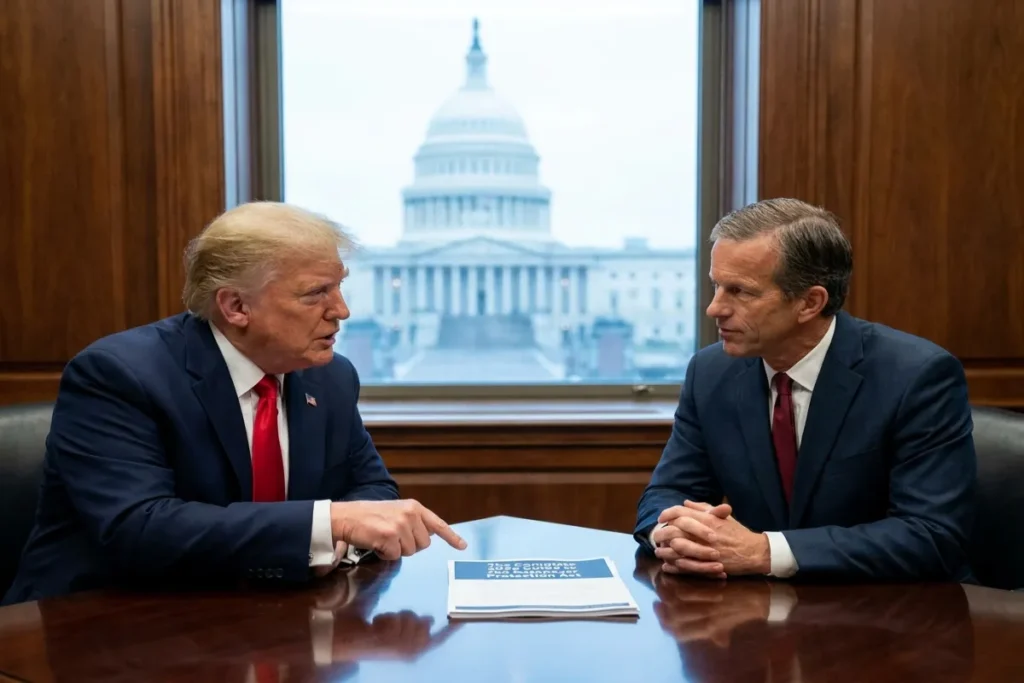
The public outcry has reached a boiling point, prompting immediate action in Washington. In a critical move for energy policy and consumer protection, Trump is talking with Senate’s Thune about bill to cut data-center electricity costs. This high-level legislative push aims to fundamentally change how grid upgrades are funded, ensuring that tech billionaires, rather than working-class families, foot the bill for the AI revolution.
In this comprehensive, deep-dive article, we will explore why data centers are draining the grid, break down the newly proposed Ratepayer Protection Act (HR 9340), analyze the current political standoff in the Senate, and provide actionable tips to help you lower your energy bills today.
How Anthropic quietly sets up biology lab as it ramps AI drug program to Revolutionize Healthcare
Table of Contents
The AI Boom and the Looming Electricity Crisis
To understand the legislative battles happening in Washington right now, one must first grasp the sheer scale of the artificial intelligence boom and its physical footprint. Artificial intelligence is not just software floating in the cloud; it is housed in massive, hyper-scale facilities that span millions of square feet.
Why Data Centers Require So Much Power
Traditional data centers, which host websites and cloud storage, are already energy-intensive. However, AI data centers are entirely different beasts. Training large language models and processing complex generative AI prompts requires specialized graphics processing units (GPUs). These GPUs run significantly hotter and demand exponentially more electricity than traditional server racks.
Furthermore, because these servers generate an immense amount of heat, the cooling systems required to keep the data centers from literally melting down draw almost as much power as the computing equipment itself. A single hyper-scale AI data center can consume as much electricity as a mid-sized American city. As of 2026, the rapid buildout of these facilities has put a strain on regional power operators like PJM Interconnection, which oversees the electric grid across 13 states from Virginia to Illinois.
The Cost to the Everyday Consumer
When a massive data center moves into a local community, the utility company must guarantee it can deliver the required gigawatts of continuous, uninterrupted power. If the local grid does not have the capacity, the utility company must build new substations, run new high-voltage transmission lines, and sometimes even recommission retired fossil fuel power plants.
Historically, utility rate-making allows power companies to divide the costs of new infrastructure across all of their customers. This means that an elderly couple on a fixed income or a local bakery could see their monthly electric bills surge simply because a tech conglomerate built an AI facility in their county. This structural unfairness is exactly why Trump is talking with Senate’s Thune about bill to cut data-center electricity costs. Lawmakers from both sides of the aisle are recognizing that this outdated economic model is no longer sustainable or fair to the American public.
Enter the Ratepayer Protection Act (HR 9340)
Recognizing the urgent need to shield everyday Americans from these indirect tech subsidies, the US House of Representatives recently took decisive action. Introduced in the summer of 2026 and heavily debated into September, the Ratepayer Protection Act (HR 9340) emerged as a potential lifeline for consumers.
Overwhelming Bipartisan Support in the House
In a rare display of near-unanimous bipartisanship, the House of Representatives voted 417 to 3 in favor of the Ratepayer Protection Act in mid-September 2026. Co-sponsored by Representative Gabe Evans, a Republican, and Representative Kathy Castor, a Democrat, the bill successfully united lawmakers who typically clash on energy policy.
The core mechanism of HR 9340 is built on existing Public Utility Regulatory Policies Act (PURPA) authorities. The legislation requires state public utility commissions to formally consider new strategies to make data centers drawing more than 100 megawatts of power pay their own way. Instead of allowing utility monopolies to automatically pass the costs of new power plants and transmission lines onto residential customers, state regulators would be heavily incentivized to force the tech companies to bear the incremental costs.
What the Bill Actually Does
While the bill has been celebrated, it is important to understand its nuances. The Ratepayer Protection Act is generally considered a modest, state-empowering framework rather than a heavy-handed federal mandate.
- State-Level Consideration: It forces state regulators to hold public hearings and establish large-load standards.
- Cost Allocation: It requires a detailed analysis of exactly how much grid expansion is directly attributable to data centers.
- Consumer Shielding: It gives local advocates and consumer protection groups a federal framework to argue against rate hikes in their specific jurisdictions.
By pushing the responsibility down to the state level, the bill avoids federal overreach while providing a robust tool to stop predatory rate hikes.
The Senate Standoff: Why Legislation is Stalling
Despite sailing through the House with flying colors, the Ratepayer Protection Act hit a massive roadblock as soon as it crossed the Capitol rotunda. The path to becoming law requires Senate approval, and in late 2026, the Senate is navigating a deeply fractured and highly polarized environment ahead of the midterm elections.
The Democratic Blockade
On the Thursday following the House vote, an attempt by Senate Republicans to get the bill quickly passed via unanimous consent failed. The effort, spearheaded by Republican Senator Jon Husted, was formally blocked by Senator Martin Heinrich, the top Democrat on the Senate Committee on Energy and Natural Resources.
Senator Heinrich’s objection was not rooted in a desire to help Big Tech, but rather in a belief that the bill was too weak. Heinrich argued that the legislation relies too heavily on voluntary commitments from states and tech developers. Because the bill asks states to “consider” requiring data centers to pay, rather than enforcing a strict federal mandate, critics argue it leaves too many loopholes for utility companies to exploit.
Other progressive lawmakers, such as Representative Rashida Tlaib, have echoed this sentiment, arguing that Congress needs to implement a national moratorium on new data center construction until strict environmental and economic safeguards are legally mandated.
The Behind-the-Scenes Negotiations
It is directly because of this Senate gridlock that Trump is talking with Senate’s Thune about bill to cut data-center electricity costs. With the midterm elections looming and inflation remaining a top voter concern, the Republican leadership views utility bill relief as a major winning issue.
President Trump confirmed to reporters in mid-September that he is actively engaging with Republican Senate Majority Leader John Thune to find a pathway to bring the bill to the Senate floor. “Well, I’m talking to him about it. We’ll see what happens,” Trump stated. The goal is to bypass the unanimous consent blockade and force a formal roll-call vote, which would put hesitant lawmakers on the record regarding consumer utility protections just weeks before an election.
The Geopolitical AI Race: Data Centers as the “New Oil”
The debate over the Ratepayer Protection Act is not just about domestic utility bills; it is deeply intertwined with global geopolitics and national security. The United States and China are currently locked in a fierce, high-stakes arms race for artificial intelligence supremacy.
Winning the Global AI Race
The federal government views advanced AI as a critical strategic asset. From military logistics to cybersecurity and economic dominance, the country that leads in AI will likely shape the global order for the next century. This requires massive computational power, which means the US absolutely must build more data centers.
President Trump has been highly vocal about this necessity. Dismissing certain existential safety concerns surrounding AI development, he recently referred to data centers as the “oil of the next 20, 25 years.” Just as petroleum fueled the industrial and economic booms of the 20th century, computational power and data infrastructure will fuel the 21st century.
The Balancing Act: National Security vs. Local Resistance
This creates a massive political paradox. The federal government desperately wants tech companies to build AI infrastructure at record speeds to outcompete China. However, the American public fiercely opposes this buildout in their own backyards.
According to a September 2026 poll by the University of Massachusetts Amherst, a staggering 89% of Americans oppose the construction of an AI data center in their community. Only 11% support it. Voters are terrified of the environmental impact, the immense strain on local water supplies for cooling, and the inevitable spikes in their monthly bills.
The challenge for lawmakers like Senator Thune is finding a legislative sweet spot. They must ensure that the Ratepayer Protection Act does not accidentally stifle the AI industry with overly burdensome regulations, while simultaneously guaranteeing that working-class voters aren’t financially punished for America’s geopolitical ambitions.
Big Tech’s Voluntary Ratepayer Protection Pledge
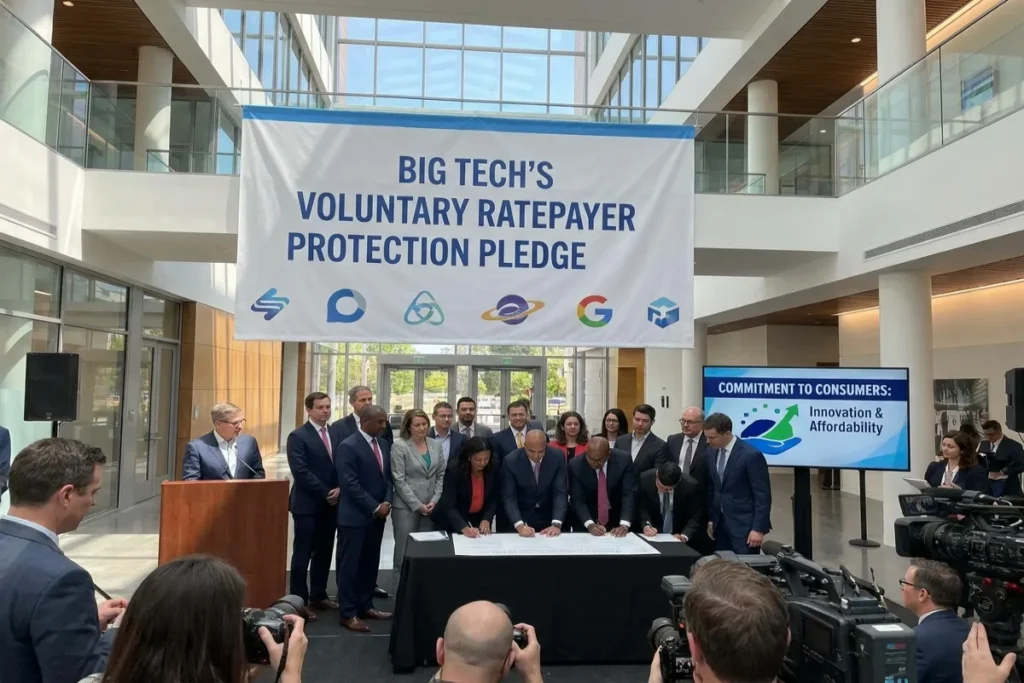
In response to the growing public backlash and the looming threat of strict legislation, the technology industry has attempted to self-regulate. Over the summer of 2026, the White House successfully brokered an agreement with the industry’s heaviest hitters.
The Corporate Commitments
A consortium of massive tech firms—including Amazon, Google, Meta, Microsoft, OpenAI, Oracle, and xAI—officially signed onto the “Ratepayer Protection Pledge.” This high-profile agreement is a public commitment that these companies will bear the financial burden of their own expansion.
By signing the pledge, these corporations agreed to “build, bring, or buy new generation resources and cover the cost of all power delivery infrastructure upgrades required for their data centers.” In theory, this pledge ensures that such expenses are entirely removed from the rate base of everyday residential consumers.
Will Voluntary Pledges Be Enough?
While the pledge represents a massive public relations victory, consumer watchdogs remain deeply skeptical. A voluntary pledge is not a binding legal contract. When a utility company actually files for a rate hike with a state public utility commission, a corporate press release holds very little legal weight in the courtroom.
Tyson Slocum, director of the energy program at a prominent consumer advocacy group, noted that there are a myriad of community and economic impacts stemming from data centers that remain totally unaddressed by voluntary pledges. This skepticism is exactly why legislative codification is necessary, and why it is so critical that Trump is talking with Senate’s Thune about bill to cut data-center electricity costs. Only federal and state laws can truly guarantee that ratepayers are shielded from the fallout of corporate expansion.
Actionable Tips: How to Protect Your Household from Surging Electricity Rates
While the politicians battle it out in Washington, you still have to pay your electric bill every month. Waiting for Congress to pass the Ratepayer Protection Act is not a viable short-term strategy. As an SEO and content expert, I want to ensure you walk away from this article with practical, actionable steps to take control of your household energy costs today.
1. Conduct a Home Energy Audit
Before you can cut costs, you need to know where your power is going. Many utility companies offer free or highly discounted home energy audits. A professional will inspect your home for air leaks, test your HVAC efficiency, and pinpoint exactly where you are wasting electricity.
2. Invest in Smart Thermostats
Heating and cooling account for roughly half of a standard home’s energy consumption. By installing a smart thermostat (like a Nest or Ecobee), you can automatically adjust temperatures when you are asleep or away from home. These devices learn your schedule and can shave 10% to 15% off your monthly HVAC costs without sacrificing comfort.
3. Shift Usage to Off-Peak Hours
Many utility companies have transitioned to “Time-of-Use” (TOU) pricing. This means electricity is significantly more expensive during peak hours (usually between 4:00 PM and 9:00 PM) when the grid is most strained. You can drastically lower your bill by running heavy appliances—like dishwashers, washing machines, and electric vehicle chargers—late at night or early in the morning when rates are drastically cheaper.
4. Upgrade Your Insulation and Weatherstripping
You are literally paying to heat and cool the outside of your neighborhood if your home is poorly insulated. Spend a weekend applying weatherstripping to doors and caulking around window frames. Furthermore, adding a fresh layer of insulation to your attic is one of the highest ROI investments a homeowner can make to permanently lower utility costs.
5. Get Involved in Local Utility Commission Hearings
Finally, do not underestimate the power of local politics. The Ratepayer Protection Act emphasizes state utility commissions. When your local power company requests a rate hike to build infrastructure for a new data center, that request must be approved by a public board. Attend these hearings, voice your opposition, and demand that the utility companies hold tech corporations accountable for their own infrastructure costs.
What the Future Holds: Powering AI Without Punishing Consumers
As we look toward the end of 2026 and into 2027, the intersection of technology and energy will remain the defining domestic issue in the United States. Artificial intelligence is not a passing fad; it is a permanent, transformative technology that will eventually integrate into every aspect of our lives and economy.
However, the physical reality of AI is that it requires unprecedented amounts of electricity. The traditional grid, built in the mid-20th century, was never designed to handle hyper-scale data centers drawing gigawatts of power around the clock. The transition to a modernized, AI-ready grid will cost hundreds of billions of dollars.
The core question facing America is simple: Who pays for it?
If the Ratepayer Protection Act passes the Senate, it will represent a monumental victory for the working class. It will legally cement the idea that multi-trillion-dollar tech companies must internalize the costs of their own massive growth. If the legislation fails, utility companies will likely continue their long-standing practice of socializing the costs of infrastructure upgrades across their entire customer base, leading to even more extreme spikes in residential electric bills.
The fact that the highest levels of government are now engaged in this fight is a promising sign. As long as leaders continue to push for consumer safeguards, there is hope that the US can maintain its leadership in global AI development without bankrupting its own citizens in the process.
Conclusion
The rapid growth of artificial intelligence has brought us incredible technological advancements, but it has also triggered a massive energy crisis that is hitting Americans right in their wallets. The House’s overwhelming support for the Ratepayer Protection Act proves that lawmakers recognize the unfairness of forcing residential consumers to subsidize Big Tech’s power infrastructure.
As we wait to see how the political chess game unfolds in the Senate, the news that Trump is talking with Senate’s Thune about bill to cut data-center electricity costs indicates that this issue is finally receiving the executive and legislative priority it deserves. Balancing America’s need to remain the global leader in AI with the absolute necessity of protecting working families from skyrocketing utility bills is the tightrope Washington must walk in the coming months.
In the meantime, take control of your own energy consumption by upgrading your home’s efficiency, utilizing off-peak billing hours, and making your voice heard at local utility board meetings. The AI revolution is here, but you should not have to empty your bank account to power it.
Call to Action: Are you tired of watching your utility bills skyrocket while tech billionaires build massive data centers in your backyard? Stay informed on the latest legislative updates and discover more expert tips on navigating the intersection of technology and your personal finances. Bookmark and subscribe to thetekworld.com today for exclusive deep-dives, tech news, and actionable guides designed to keep you ahead of the curve!
Frequently Asked Questions (FAQ)
1. What is the Ratepayer Protection Act (HR 9340)?
The Ratepayer Protection Act is a bipartisan piece of federal legislation designed to protect residential consumers from sudden spikes in their electricity bills. It requires state public utility commissions to consider frameworks that force large data centers (drawing over 100 megawatts) to pay for their own grid upgrades, rather than passing those infrastructure costs onto everyday households.
2. Why do AI data centers use so much electricity?
Unlike traditional data centers, AI facilities rely on highly advanced Graphics Processing Units (GPUs) to train massive machine learning models. These GPUs consume enormous amounts of power to run calculations and generate so much heat that they require highly energy-intensive liquid and air cooling systems to prevent the servers from overheating.
3. Why did the Senate block the Ratepayer Protection Act?
While the bill passed the House with a 417-3 vote, a fast-track attempt in the Senate was blocked by Senator Martin Heinrich (D). He argued that the bill did not go far enough to protect consumers because it only requires states to “consider” making data centers pay, rather than enforcing a strict, unavoidable federal mandate.
4. What is the Big Tech “Ratepayer Protection Pledge”?
The Ratepayer Protection Pledge is a voluntary agreement signed by major tech companies like Amazon, Google, Meta, Microsoft, and OpenAI. By signing it, they publicly committed to paying for the new generation resources and power infrastructure upgrades required for their data centers, theoretically shielding residential consumers from those costs.
5. How can I lower my electricity bill while waiting for this law to pass?
You can lower your bill immediately by conducting a home energy audit, sealing air leaks around doors and windows, upgrading your attic insulation, and installing a smart thermostat. Additionally, check if your utility provider offers “Time-of-Use” pricing, which allows you to run heavy appliances during off-peak hours for a fraction of the cost.

Comments