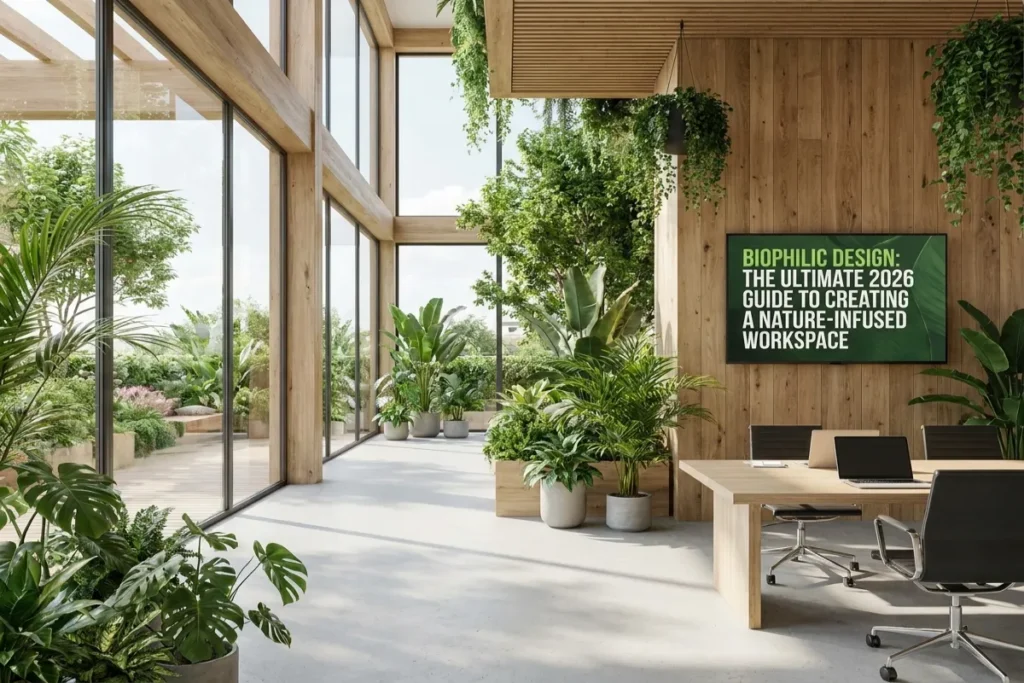
For decades, modern office design prioritized industrial efficiency over human biology. Synthetic drywall boxes, flickering fluorescent lighting tubes, laminate plastic desks, and sealed windows created environments completely detached from the natural world. This sensory deprivation contributes to what environmental psychologists call “Sick Building Syndrome”—a state marked by chronic visual fatigue, elevated cortisol levels, headaches, and rapid cognitive burnout.
In 2026, the global workforce is embracing a powerful counter-movement: Biophilic Design. Grounded in evolutionary biology, cognitive neuroscience, and interior architecture, biophilic principles incorporate natural sunlight, living flora, raw organic textures, and dynamic environmental rhythms directly into working environments.
Rather than viewing plants and wooden finishes as simple decoration, adopting a comprehensive Biophilic Design strategy transforms your home office into a high-performance sanctuary for focus, health, and psychological well-being. This guide breaks down the science, design pillars, room layouts, and practical steps needed to bring the restorative power of nature into your everyday workflow.
Earthy Tones & Restorative Darks: The Ultimate 2026 Guide to Calm, High-Focus Workspaces
Table of Contents
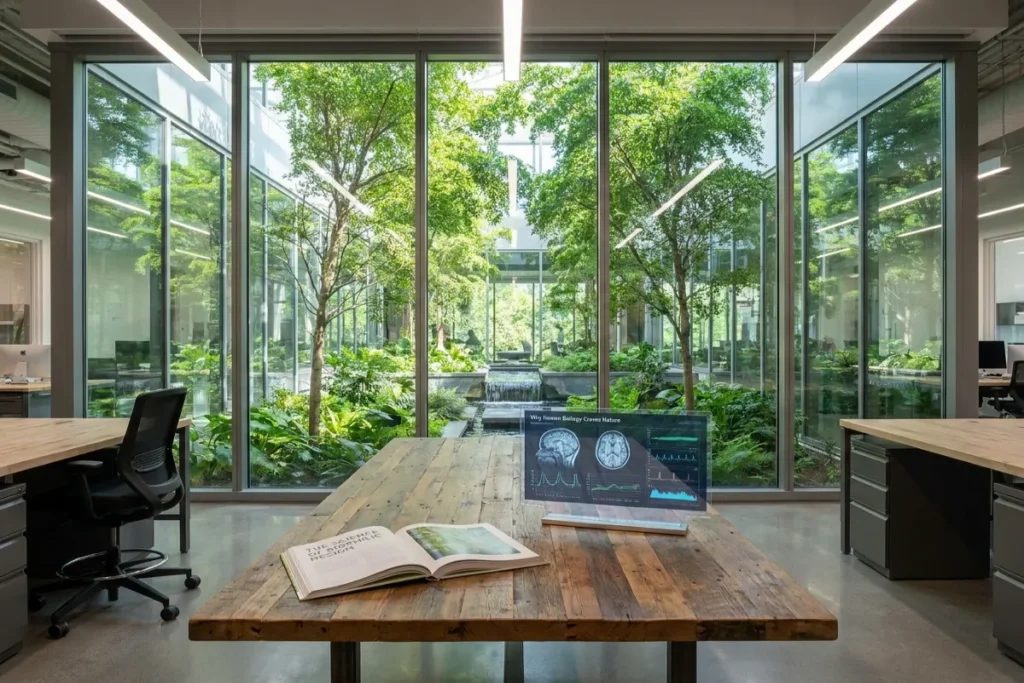
The Science of Biophilic Design: Why Human Biology Craves Nature
Humans evolved outdoors in direct contact with natural ecosystems for over 99% of our species’ history. Our neurological, circadian, and endocrine systems are hardwired to respond to natural light cycles, foliage patterns, fresh air movement, and organic color palettes.
Placing a human mind inside a sterile, synthetic environment creates subconscious stress. Environmental psychologists evaluate this disconnect through two foundational scientific frameworks:
+-------------------------------------------------------------------------+
|                 SYNTHETIC VS. BIOPHILIC WORKSPACE EFFECTS               |
|                                                                         |
|   SYNTHETIC / ISOLATED ENVIRONMENT:                                     |
|   - Sealed drywall, static fluorescent lighting, plastic laminates       |
|   - Triggers elevated cortisol, eye strain, and mental fatigue          |
|   - Depletes directed attention within 2 to 3 hours                     |
|                                                                         |
|   BIOPHILIC / NATURE-INFUSED ENVIRONMENT:                               |
|   - Living plants, dynamic daylighting, natural timber & stone          |
|   - Lowers heart rate, activates parasympathetic calm                   |
|   - Restores prefrontal cortex focus and creative problem-solving       |
+-------------------------------------------------------------------------+
1. Stress Recovery Theory (SRT)
Developed by Dr. Roger Ulrich, Stress Recovery Theory proves that visual exposure to natural elements triggers immediate physiological recovery. When your eyes rest on living plants, natural wood grain, or daylight, your parasympathetic nervous system activates within minutes. Blood pressure drops, heart rate variability improves, and the adrenal gland reduces cortisol production.
2. Attention Restoration Theory (ART)
Formulated by Stephen and Rachel Kaplan, Attention Restoration Theory explains how modern screen work causes “directed attention fatigue.” Staring at spreadsheets, code, or video calls forces the prefrontal cortex to exert continuous energy filtering out distractions.
Nature, by contrast, engages “soft fascination”—a effortless form of visual processing that allows the brain’s executive focus center to rest and restore its cognitive capacity.
The Three Core Pillars of Biophilic Workspaces
To implement Biophilic Design effectively, architectural researchers categorize nature integration into three distinct pillars: Direct Experience, Indirect Experience, and Spatial Conditions.
+-------------------------------------------------------------------------+
|                     THE 3 PILLARS OF BIOPHILIC DESIGN                   |
|                                                                         |
|   [1. DIRECT NATURE]          [2. INDIRECT NATURE]        [3. SPATIAL CONDITIONS]|
|   - Living Greenery & Moss    - Solid Wood & Raw Stone    - Prospect (Clear Views)|
|   - Natural Sunlight & Views  - Organic Curved Shapes     - Refuge (Sheltered Nook)|
|   - Fresh Air & Water Sound  - Fractal Geometries        - Dynamic Light Transitions|
+-------------------------------------------------------------------------+
Pillar 1: Direct Experience of Nature
Direct experience refers to physical, tangible contact with living natural systems within your room.
- Living Greenery: Potted plants, living plant walls, and desktop terrariums that purify indoor air while providing visual energy.
- Natural Light & Views: Positioning desks near windows to receive unobstructed sunlight and views of trees, gardens, or open sky.
- Air Circulation: Operable windows, quiet ceiling fans, or HEPA air purifiers that introduce subtle air movement across the skin.
- Water Features: Small desktop fountains or water channels that provide soothing visual motion and gentle auditory masking.
Pillar 2: Indirect Experience of Nature
When direct access to natural features is limited, indirect representations evoke similar calming neurological responses.
- Natural Materials: Unfinished solid woods (walnut, oak, cedar), natural stone, slate coasters, linen curtains, and wool felt desk pads.
- Biomorphic Shapes & Forms: Curved desk edges, pill-shaped tables, arched wall alcoves, and organic lamp silhouettes that avoid harsh 90-degree synthetic corners.
- Fractal Geometries: Wall Art, woven rugs, or acoustic wooden wall slats featuring self-repeating patterns found in leaves, ferns, ocean waves, and snowflakes.
Pillar 3: Spatial and Experience Conditions
Spatial conditions dictate how your body feels within the architectural layout of the room.
- Prospect (Clear Line of Sight): Positioning your workspace so your eyes can scan open pathways, doors, and windows, satisfying an evolutionary need for spatial awareness.
- Refuge (Shelter and Security): Creating cozy, protected nooks using high-backed chairs, warm acoustic wall tiles, or overhead canopy shelves to foster deep concentration.
- Dynamic & Diffused Lighting: Layering fixtures to replicate the natural variance of sunlight filtering through forest leaves throughout the day.
Interactive Biophilic Office Assessment Tool
Use the interactive visual tool below to assess your current workspace and receive a customized biophilic score alongside tailored plant, lighting, and material recommendations.
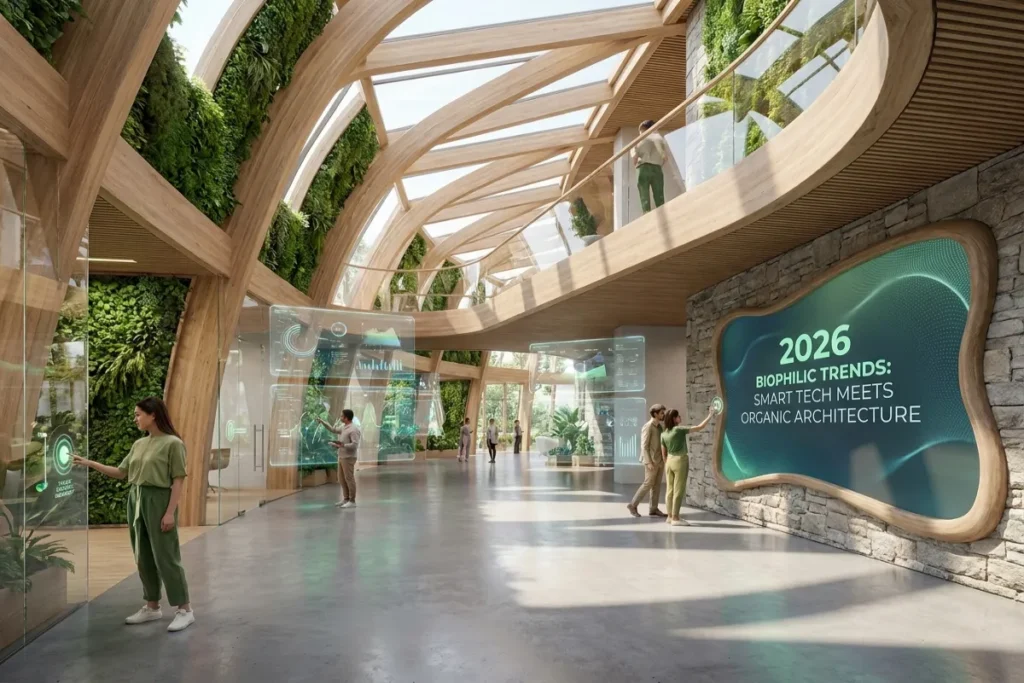
2026 Biophilic Design Trends: Smart Tech Meets Organic Architecture
The modern iteration of biophilic design does not mean abandoning technology. Instead, 2026 trends focus on leveraging smart home innovations to replicate natural cycles indoors.
1. Smart Solar-Tracking Circadian Lighting
Lighting systems now automatically adjust their spectral output throughout the day. In the morning, lights emit cool 5000K daylight spectrum to stimulate cortisol and wakefulness. By late afternoon, they shift to warm 2700K amber tones, mimicking the setting sun to protect your body’s melatonin production.
2. Hydroponic Vertical Living Walls
Compact, self-watering vertical gardens are replacing standard bookshelf clutter. These modular wall panels feature integrated full-spectrum LED grow lights and silent water pumps, allowing you to grow air-purifying plants, ferns, or herbs on indoor vertical surfaces.
3. Preserved Reindeer Moss Acoustic Art
Acoustic control meets natural art with preserved moss panels. Made from harvested mosses mounted on felt backings, these installations absorb high-frequency room echoes during calls while introducing vibrant green textures that require zero watering or sunlight.
4. Natural Wood-Slat Wall Panels
Acoustic wood slats installed over dark felt backings add vertical lines that evoke tree trunks in a forest, while dramatically dampening room noise and softening hard drywall surfaces.
Plant Selection Matrix for Low-Maintenance Home Offices
Choosing the right indoor plants ensures your living greenery thrives without becoming a source of maintenance stress:
| Plant Species | Light Requirement | Maintenance Level | Air Purification & Health Benefit | Ideal Desk / Room Placement |
| Snake Plant (Sansevieria) | Low to Bright Indirect | Very Low (Water monthly) | Filters formaldehyde, benzene, and releases night oxygen | Floor corners, dark shelf niches |
| ZZ Plant (Zamioculcas) | Low to Medium Indirect | Extremely Low (Tolerates neglect) | Removes toxins, features glossy leaves that reflect light | Desktop corner, side credenza |
| Pothos (Devil’s Ivy) | Low to Bright Indirect | Low (Water when dry) | Rapid growth, purifies indoor air toxins | Hanging baskets, floating wall shelves |
| Monstera Deliciosa | Medium to Bright Indirect | Moderate (Water weekly) | Large fenestrated leaves create dramatic tropical shadows | Floor space next to main desk |
| Peace Lily (Spathiphyllum) | Medium Low | Moderate (Likes moisture) | Filters indoor humidity and acetone vapors | Credenza near indirect daylight |
5 Practical Steps to Implement Biophilic Design Today
Transforming a sterile home office into a nature-infused environment can be executed in five manageable steps:
1. Position Your Desk for Daylight and Views
Place your desk perpendicular to or facing a window rather than staring directly at a blank interior wall. Facing natural daylight provides healthy eye breaks while aligning your circadian rhythm with the outdoor sun.
2. Introduce Three Layers of Greenery
Structure your plants across three visual heights: a small potted plant on your desk deck (eye level), a trailing Pothos on a floating shelf above (high level), and a large potted Monstera or Fiddle Leaf Fig on the floor (low level). This creates a layered canopy effect.
3. Replace Synthetic Desk Accessories with Wood and Stone
Swap plastic pencil holders, mouse pads, and trays for solid walnut desk organizers, wool felt desk pads, and real stone coasters. Touching natural surfaces throughout the day offers continuous tactile grounding.
4. Incorporate Soothing Soundscapes
Mask jarring street or HVAC noise using a compact water fountain or a smart speaker streaming ambient rainforest, river, or ocean wave soundscapes at low volume (around 40-45 dB).
5. Decorate with Biomorphic Patterns and Earth Colors
Replace abstract geometric prints with botanical artwork, landscape photography, or wallpaper featuring leaf patterns. Complement these with warm terracotta, sage green, or muted sand wall paint.
Elevate Your Workspace with The Tek World
Embracing Biophilic Design is more than an aesthetic upgrade; it is an investment in your mental clarity, physical health, and daily productivity. By bridging the gap between human architecture and natural ecosystems, you create a workspace where deep focus and personal well-being thrive together.
Looking for in-depth reviews on hydroponic planters, circadian smart lighting, solid wood standing desks, and acoustic moss panels updated for 2026? Visit thetekworld.com for expert buying advice and practical tutorials designed to elevate your lifestyle!
Frequently Asked Questions (FAQ)
1. Can I practice biophilic design in a windowless room or basement office?
Yes. In windowless spaces, rely heavily on indirect natural elements: install smart circadian LED lights that mimic daylight cycles, use natural wood furniture, display high-resolution nature photography, and select low-light indoor plants (like ZZ plants or Snake plants) paired with a small LED grow light.
2. How many plants do I need to experience the cognitive benefits of biophilic design?
Research suggests that having just 3 to 5 visible plants within your direct line of sight is enough to trigger measurable reductions in blood pressure and mental fatigue. The goal is visual harmony, not turning your desk into an overgrown jungle that creates clutter.
3. What is the difference between biomimicry and biophilic design?
Biomimicry is an engineering discipline that copies nature’s structural mechanics to solve technical human problems (e.g., designing fan blades based on whale fins). Biophilic design is an architectural and interior discipline focused on incorporating natural elements into built environments to improve human physiological and psychological health.
4. Are artificial fake plants effective for biophilic design?
High-quality silk or faux plants provide visual benefits and “soft fascination,” helping rest your eyes. However, they lack the direct biological benefits of real plants, such as air purification, natural oxygen release, subtle natural scents, and the psychological satisfaction of nurturing living greenery.
