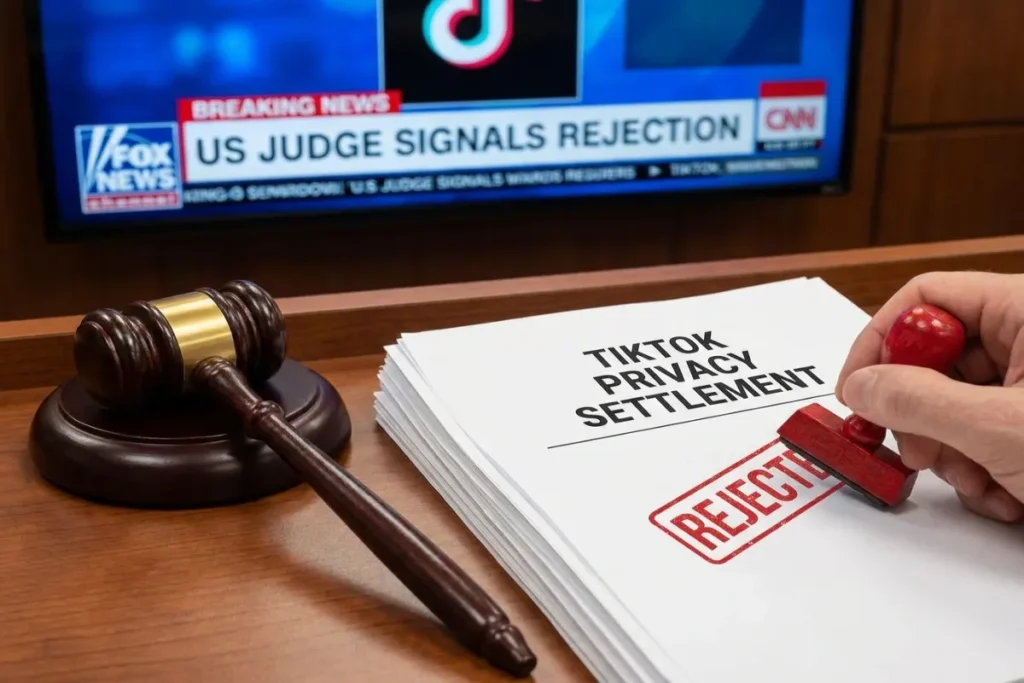
In the constantly shifting landscape of digital data rights, major tech conglomerates often find themselves locked in high-stakes legal battles with federal regulators. Recently, a massive development has captured the attention of legal scholars, tech executives, and everyday social media users alike. It became headline news when a US judge signals rejection of part of TikTok privacy settlement, throwing a carefully negotiated $400 million agreement with the United States Justice Department into a state of deep uncertainty.
For years, users have worried about how much data their favorite applications harvest, store, and potentially misuse. This is especially concerning when the target demographic includes minors and young children. The ongoing saga between TikTok, its Chinese parent company ByteDance, and the US government is not just a standard corporate lawsuit—it is a defining battle for the future of digital privacy in 2026. This article breaks down exactly why this proposed settlement hit a judicial brick wall, explores the historical context of TikTok’s data practices, and outlines what this means for both consumers and businesses operating in the digital space.
Table of Contents
The Origin Story: From Musical.ly to the 2024 DOJ Lawsuit
To truly understand why the court is taking such a rigid stance today, we must rewind the clock and examine the origins of the platform’s regulatory troubles. The foundation of this current legal impasse was actually laid long before TikTok became the dominant cultural force it is today.
The Ghost of Musical.ly and the 2019 Consent Decree
Before there was TikTok, there was Musical.ly. In 2019, the Federal Trade Commission (FTC) determined that Musical.ly knew young children were actively using the app, yet fundamentally failed to obtain verifiable parental consent before collecting sensitive personal information. This data included names, email addresses, and location metrics. This blatant violation of the Children’s Online Privacy Protection Act (COPPA) resulted in a $5.7 million fine, which at the time was a record-breaking penalty.
More importantly, the settlement resulted in a legally binding consent decree. This decree required TikTok (which had subsequently folded Musical.ly into its own operations) to maintain rigorous, ongoing reporting and record-keeping obligations through the year 2029. This consent decree acted as a federal leash, ensuring that the company’s data practices remained under the strict scrutiny of US regulators for a full decade.
The Escalation: The 2024 DOJ Lawsuit
Despite the 2019 decree, federal concerns regarding TikTok’s data practices did not fade—they amplified. In 2024, the US Justice Department launched a massive, comprehensive lawsuit against TikTok and ByteDance. The government accused the companies of systematically failing to protect children’s privacy and illegally harvesting the personal information of users under the age of 13.
The stakes in 2024 were astronomically higher than in 2019. The application now boasted over 200 million American users, embedding itself into the fabric of daily life, e-commerce, and political discourse. The government argued that TikTok’s internal mechanisms were wildly insufficient for verifying user ages, meaning millions of children were exposed to invasive data-tracking algorithms without their parents’ knowledge or permission. This aggressive legal action eventually forced TikTok and ByteDance to the negotiating table, resulting in the massive settlement proposed in August of 2026.
Unpacking the 2026 $400 Million Settlement
By August 2026, TikTok and the Justice Department had seemingly reached an agreement to finally put the allegations to rest. The proposed settlement was historic in its scope and financial penalty, designed to hold the company accountable while allowing it to continue operating within the United States.
Breaking Down the Numbers
The structure of the settlement was highly specific. ByteDance agreed to a total penalty of $400 million. However, the payment was split into two distinct tiers:
- The Immediate Penalty: TikTok agreed to pay $300 million to the government immediately upon the settlement’s approval. 94.7 The Beast
- The Contingent Penalty: The remaining $100 million was tied to a very specific legal condition—it would only be paid if the court formally terminated the 2019 FTC consent decree that governed the company’s record-keeping obligations. 94.7 The Beast
From TikTok’s perspective, this deal made perfect strategic sense. They would pay a heavy fine, but in exchange, they would finally shed the burdensome federal oversight that had been breathing down their neck since the Musical.ly days. The government, acknowledging that TikTok had made significant structural and management changes, was initially unopposed to vacating the old order.
The Joint Venture Defense
To sweeten the deal and prove their commitment to data security, ByteDance highlighted a major structural shift they had initiated earlier in the year. In January 2026, ByteDance agreed to establish a majority American-owned joint venture. This new entity was explicitly designed to safeguard US user data, effectively walling off American information from foreign servers, and successfully averting a total US ban of the application.
TikTok argued that between this new American-owned structure, sophisticated new age-moderation systems, and completely overhauled compliance functions, the 2019 consent decree was obsolete. They believed they had evolved past the need for the decade-long federal leash.
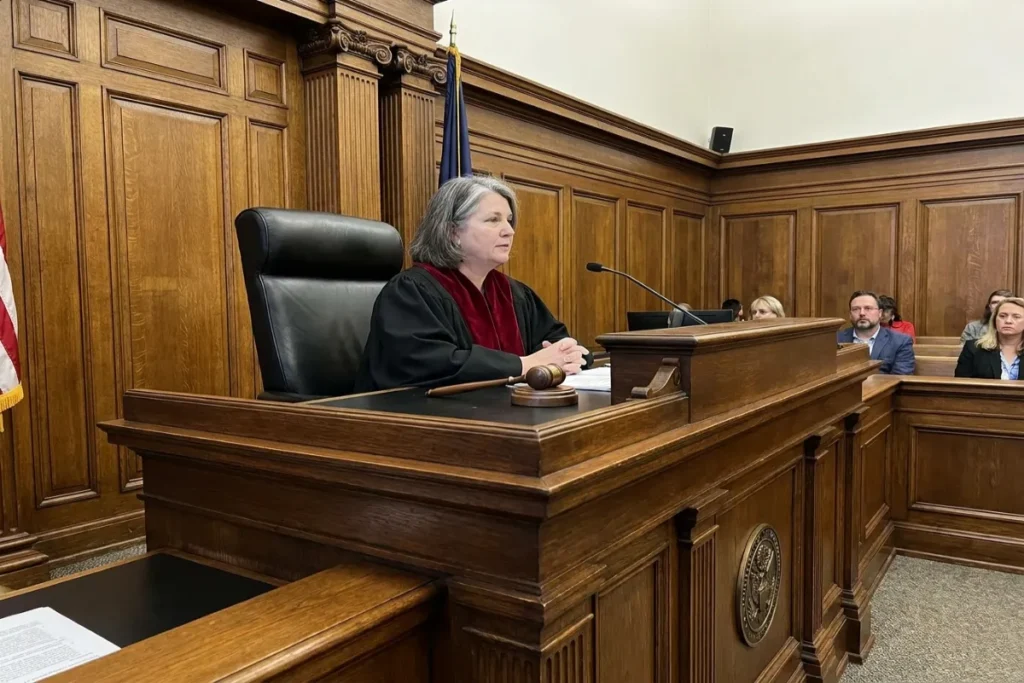
Why the US judge signals rejection of part of TikTok privacy settlement
Despite the agreement between the Justice Department and TikTok’s legal team, a settlement of this magnitude must be approved by a federal judge. This is where the carefully crafted deal hit a brick wall. When the US judge signals rejection of part of TikTok privacy settlement, it immediately threw the $100 million contingent payment into limbo and ensured that federal oversight would remain active.
Judge George H. Wu’s Tentative Ruling
On a Friday in mid-September 2026, US District Judge George H. Wu in Los Angeles evaluated the proposed settlement and tentatively refused to lift the seven-year-old consent order. His reasoning was deeply rooted in the fundamental purpose of federal regulatory oversight.
Judge Wu stated that the court “cannot determine that it constitutes a durable remedy or that termination is suitably tailored to the asserted change in circumstance”. In plain English, the judge was not convinced that TikTok’s recent internal changes—such as their American-owned joint venture and new age-gating software—were permanent, foolproof solutions that justified removing federal supervision.
The Concept of a “Durable Remedy”
The phrase “durable remedy” is critical in understanding this judicial pushback. When the FTC places a company under a consent decree, the goal is long-term behavioral correction. Judge Wu essentially argued that buying your way out of a consent decree with a $100 million conditional payment does not prove that the underlying cultural and technological issues regarding child privacy have been permanently solved.
Because the US judge signals rejection of part of TikTok privacy settlement, the court is sending a very clear message: financial penalties, no matter how large, cannot be used to simply purchase freedom from regulatory oversight, especially when the data of minors is involved. The government failed to convince the judge that TikTok’s new safeguards made the 2019 order completely unnecessary.
The Wider Impact on Tech Companies and Data Privacy
The fact that a US judge signals rejection of part of TikTok privacy settlement is a watershed moment for the entire technology industry. It sets a powerful legal precedent that will echo through Silicon Valley and beyond.
A Warning Shot to Big Tech
For years, massive technology firms have operated under the assumption that if they break data privacy laws, they can simply absorb the resulting fines as a “cost of doing business.” They would pay the penalty, promise to do better, and move on. Judge Wu’s ruling disrupts this model. By refusing to lift the consent decree, the court is prioritizing ongoing operational compliance over a one-time massive payout.
If this tentative ruling holds after the scheduled hearings, other companies currently operating under FTC consent decrees (such as Meta and X/Twitter) will realize that escaping federal oversight is going to be incredibly difficult. Regulators and judges are increasingly demanding verifiable, structural, and permanent changes to data architecture before they will release a company from federal supervision.
Global Regulatory Momentum
The United States is not acting in a vacuum. The tentative rejection aligns with a broader global crackdown on algorithmic social media platforms. For instance, the European Commission is actively increasing its supervision of TikTok under the Digital Services Act. Interestingly, the EU is focusing heavily on the app’s “addictive design” and its psychological impact on minors, rather than just data collection.
When you combine the EU’s aggressive oversight with the US court’s refusal to lift the consent decree, it becomes abundantly clear that the era of unregulated, “Wild West” social media expansion is officially over.
Practical Examples: How TikTok’s Age-Moderation Actually Works
To understand what TikTok has attempted to do to satisfy regulators, it is helpful to look at the practical examples of their new privacy infrastructure. In their court filings, the TikTok US joint venture outlined several sophisticated systems designed to identify and protect users under the age of 13.
- Mandatory Date of Birth Gates: Unlike the early days of Musical.ly where users could freely browse, the platform now forces a hard “date of birth” entry wall before a user can access the site’s content. 94.7 The Beast
- Behavioral AI Identification: The platform claims to use sophisticated age-moderation systems powered by machine learning. If an account claims to be 18, but the user’s viewing habits, search queries, and interaction metrics align almost exclusively with pre-teen behavioral models, the system flags the account for review. 94.7 The Beast
- Restricted Direct Messaging: For users who are verifiably between the ages of 13 and 15, the platform imposes severe restrictions on direct messaging and who can comment on their videos, creating a walled-garden effect to prevent predatory behavior.
Despite these practical examples of innovation, Judge Wu’s skepticism highlights a universal truth in cybersecurity: if a teenager wants to bypass an age-gate, they will often find a way. Until these systems are proven to be infallible, the court prefers to keep the federal leash attached.
Actionable Tips for Parents: Protecting Your Children on Social Media
While the federal courts battle over corporate consent decrees, parents need immediate, actionable strategies to protect their children’s data today. You cannot wait for the conclusion of a DOJ lawsuit to secure your family’s digital footprint.
- Utilize Family Pairing Features: Both TikTok and other major platforms offer “Family Pairing” or comprehensive parental controls. Link your account to your child’s account. This allows you to set strict screen time limits, restrict inappropriate content, and disable direct messaging entirely.
- Audit Application Permissions: Go into the settings of your child’s smartphone. Ensure that social media applications do not have passive access to location services, the microphone, or the camera unless the app is actively being used.
- Teach Data Literacy: Have an open, honest conversation with your children about what data is. Explain that everything they click, watch, and search for is recorded to build a profile on them. Teaching a child to be skeptical of the internet is the strongest privacy filter you can install.
- Enforce the Age Minimums: COPPA exists for a reason. Do not allow your child to lie about their birth year to access platforms meant for teenagers and adults. The algorithms on these apps are aggressively optimized for older demographics and can expose young children to harmful content and severe data harvesting.
Actionable Tips for Businesses: Mastering Privacy Compliance
If you run a digital business, develop applications, or operate an e-commerce platform, the fact that a US judge signals rejection of part of TikTok privacy settlement should be a massive wake-up call. Here is how you can ensure your business remains compliant and avoids the wrath of federal regulators.
- Adopt Privacy by Design: Do not treat data privacy as an afterthought or a quick patch before launch. Build your applications with “Privacy by Design” principles. This means collecting the absolute minimum amount of data required for your service to function. If you don’t need a user’s location to provide your service, do not ask for it.
- Implement Ironclad Age Verification: If your platform has any appeal to minors, a simple “Check this box if you are over 13” is no longer legally sufficient. Invest in third-party age verification APIs that utilize robust identity checks to ensure you are not inadvertently violating COPPA regulations.
- Audit Your Data Retention Policies: Be explicitly clear about how long you keep user data. If a user deletes their account, their data should be purged from your servers immediately. Maintaining “zombie data” is a massive liability in the event of a breach or a federal audit.
- Prepare for the End of the “Slap on the Wrist”: As seen in the TikTok case, the courts are no longer accepting financial settlements as a total cure for systemic privacy issues. Ensure your compliance frameworks are deeply embedded into your corporate culture, because regulatory oversight is becoming permanent.
Conclusion
The ongoing legal drama surrounding the world’s most popular short-video application is a masterclass in the complexities of modern digital law. When a US judge signals rejection of part of TikTok privacy settlement, it is a definitive statement that the federal government is no longer willing to trade long-term regulatory oversight for short-term financial payouts.
The transition from the $5.7 million Musical.ly fine in 2019 to a heavily scrutinized $400 million settlement in 2026 illustrates just how seriously the United States is taking the protection of children’s digital data. As TikTok scrambles to prove that its American-owned joint venture and advanced age-gating algorithms constitute a “durable remedy,” the rest of the tech industry is watching closely. The outcome of this case will set the standard for how data privacy, algorithmic accountability, and corporate compliance are handled for the next decade.
Call to Action: Data privacy laws are evolving at breakneck speed, and staying informed is the only way to protect yourself and your business. Do you think federal judges should maintain permanent oversight over massive social media platforms? Let us know your thoughts in the comments below! Don’t forget to bookmark and subscribe to thetekworld.com for the latest deep dives, expert SEO insights, and breaking news in the world of technology and digital rights.
Frequently Asked Questions (FAQ)
1. Why did the US judge reject the TikTok privacy settlement?
US District Judge George H. Wu tentatively rejected a key part of the $400 million settlement because he was not convinced that terminating a 2019 FTC consent decree was a “durable remedy.” He felt the court needed more proof that TikTok’s recent internal changes permanently solved the issues surrounding children’s data privacy before lifting federal oversight.
2. What is the 2019 FTC consent decree?
In 2019, Musical.ly (the predecessor to TikTok) was fined $5.7 million for violating the Children’s Online Privacy Protection Act (COPPA). Part of that settlement included a consent decree, which placed the company under strict federal reporting and record-keeping obligations through the year 2029 to ensure they stopped illegally harvesting data from children under 13.
3. How much was the 2026 TikTok privacy settlement worth?
The proposed settlement with the US Justice Department was for $400 million. TikTok agreed to pay $300 million upfront, with the remaining $100 million contingent upon the court agreeing to terminate the 2019 consent decree.
4. What is the TikTok US joint venture?
In January 2026, ByteDance agreed to establish a majority American-owned joint venture. This corporate restructuring was aimed at safeguarding US user data on domestic servers to avert a threatened ban of the app by the United States government.
5. How does TikTok claim to protect children’s privacy now?
According to court filings, TikTok now requires all users to enter their date of birth to use the platform. Furthermore, the company states it has developed sophisticated, AI-driven age-moderation systems that analyze user behavior to identify and restrict children under 13 who have misrepresented their age.
