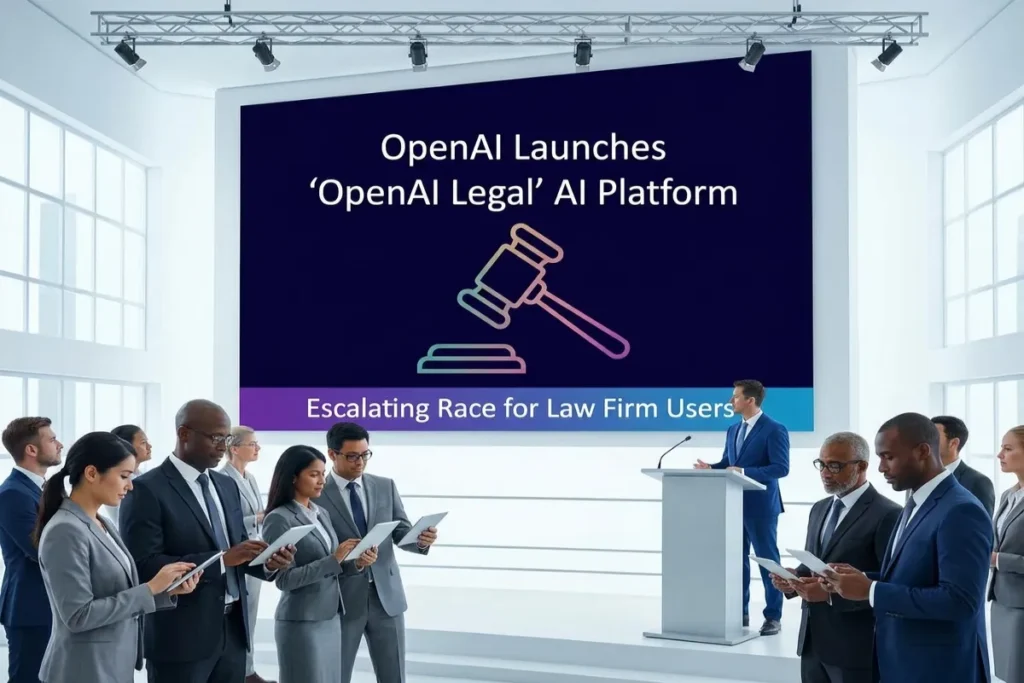
The global battle for the legal technology market has reached a monumental boiling point. Tech giants and artificial intelligence pioneers are no longer just offering generic productivity models; they are rolling out hyper-specialized, deeply integrated legal ecosystems designed to dominate firm workflows. OpenAI launches legal-focused AI platform, escalating race for law firm users, marking a definitive structural shift in how attorneys research case law, draft briefs, and structure complex litigation.
For modern law practices, corporate legal departments, and legal tech developers, this launch reshapes the competitive landscape. At thetekworld.com, we analyze what this major deployment brings to the table, how it stacks up against competing tools, and what it means for the future of legal practice management.
The New Frontier: Breaking Down OpenAI’s Legal Strategy
The legal sector has traditionally been protective of data privacy, slow to adopt unvetted software, and heavily reliant on meticulous, human-driven research. Recognizing these unique demands, OpenAI introduced its targeted legal infrastructure—built around its powerful GPT-6 architecture—to bridge the gap between general reasoning and professional legal execution.
Tailored Configurations: Rather than relying on simple prompt engineering, the platform embeds context, custom tools, and strict guidelines designed specifically for legal analysis and brief drafting.
Massive Case Law Corpus: By integrating deep legal search capabilities spanning over hundreds of millions of data points and partnering with organizations like the Free Law Project (CourtListener), the tool accesses an expansive library of precedential U.S. case law.
Ecosystem Integration: The platform launches alongside dozens of ecosystem and partner plugins, connecting seamlessly with everyday legal infrastructure like document management and billing systems.
Core Capabilities Driving the Legal Tech Arms Race
As OpenAI launches legal-focused AI platform, escalating race for law firm users, the benchmark for what artificial intelligence can achieve inside a law firm has fundamentally shifted. Practitioners are moving away from basic text generation toward deep, multi-step autonomous reasoning.
1. Embedded Legal Research & Authority Matching
Traditional large language models often struggle with hallucinated citations or outdated rulings. The new platform pairs advanced reasoning with a comprehensive legal search index, yielding significant performance leaps on evaluation metrics compared to web-search-only baselines. Lawyers can pinpoint exact statutory rules, regulations, and administrative decisions with heightened precision.
2. Argument Construction and Vulnerability Identification
Beyond simply locating text, the system utilizes customized instructions to help lawyers apply research directly to a client’s specific factual scenario. It assists in drafting motions, developing contract terms, and—crucially—identifying vulnerabilities or conflicting precedents that an opposing counsel might exploit.
Actionable Tip for Law Practices: When onboarding legal AI platforms, establish an internal prompt library. Train your associates to use the AI not just for final drafting, but as a rigorous “red team” adversary to stress-test your arguments before filing.
How It Compares in the Escalating Tech Landscape
OpenAI’s strategic move does not happen in a vacuum. The race to capture legal firm adoption has turned into a high-stakes chess match among major industry players:
Tech Provider
Platform / Solution
Key Focus Area
OpenAI
Astra for Law
Deep GPT-6 reasoning, legal search index, and flexible ecosystem APIs
Anthropic
Claude for Legal
Advanced contextual synthesis and long-form document handling
Microsoft
Legal Agent in Word
Deep integration directly inside office drafting software
Google
Gemini Enterprise for Legal
Enterprise-grade cloud scaling and multi-modal document parsing
The intense competition means law firms are no longer starving for options; instead, they face the sweet dilemma of choosing which specialized ecosystem best fits their institutional memory and operational habits.
Security, Privacy, and Confidentiality Controls
Law firms handle sensitive client data that requires absolute confidentiality. Recognizing that security is the ultimate dealbreaker in legal tech, OpenAI’s legal configuration includes robust governance measures:
Trusted Access Programs: Specially designated access frameworks ensure that only authorized legal professionals and supervised staff interact with the environment.
Zero Data Retention (ZDR): Strict enterprise-grade data handling policies ensure that proprietary client matters and private case files are never stored or repurposed for general model training.
Exclusion from Human Review: Default protocols block human review procedures on enterprise legal workspaces, safeguarding attorney-client privilege.
Conclusion
The reality that OpenAI launches legal-focused AI platform, escalating race for law firm users underscores a broader truth: artificial intelligence is now foundational infrastructure for professional services. Firms that embrace secure, specialized AI frameworks will dramatically cut down routine research hours, freeing attorneys to focus on high-value strategic counseling.
To stay ahead of fast-moving tech deployments, regulatory shifts, and digital transformation strategies, keep checking back at thetekworld.com.
Are you ready to integrate specialized legal AI into your practice, or are you taking a wait-and-see approach? Share your thoughts in the comments or share this article with your colleagues!
Frequently Asked Questions (FAQ)
1. What is OpenAI’s legal-focused AI platform?
It is a specialized configuration of OpenAI’s advanced AI models (such as GPT-6 Astra) tailored specifically for legal professionals. It features a dedicated legal search index, custom legal analysis instructions, ecosystem plugins, and strict data privacy controls.
2. How does it protect attorney-client confidentiality?
The platform offers dedicated trusted access frameworks, zero data retention (ZDR) options for API implementations, and strict default exemptions from human review processes to protect sensitive client matters.
3. How does this platform differ from standard web-search AI tools?
Unlike general models that rely on generic internet scraping, legal-specific configurations draw directly from verified legal corpora (such as court opinions and statutes via partnerships with organizations like the Free Law Project), resulting in dramatically fewer hallucinated citations and higher legal reasoning correctness.
4. Where can I find more tech industry updates and expert analysis?
You can find continuous, up-to-date coverage of artificial intelligence trends, software rollouts, and enterprise tech strategies right here at thetekworld.com.